Self Evaluation on Factor Theorem-Factorization ICSE Class 10 Maths OP Malhotra (2026-27). We Provide Step by Step Solutions of self evaluation on Factor Theorem. Visit official Website CISCE for detail information about ICSE Board Class-10 Mathematics.
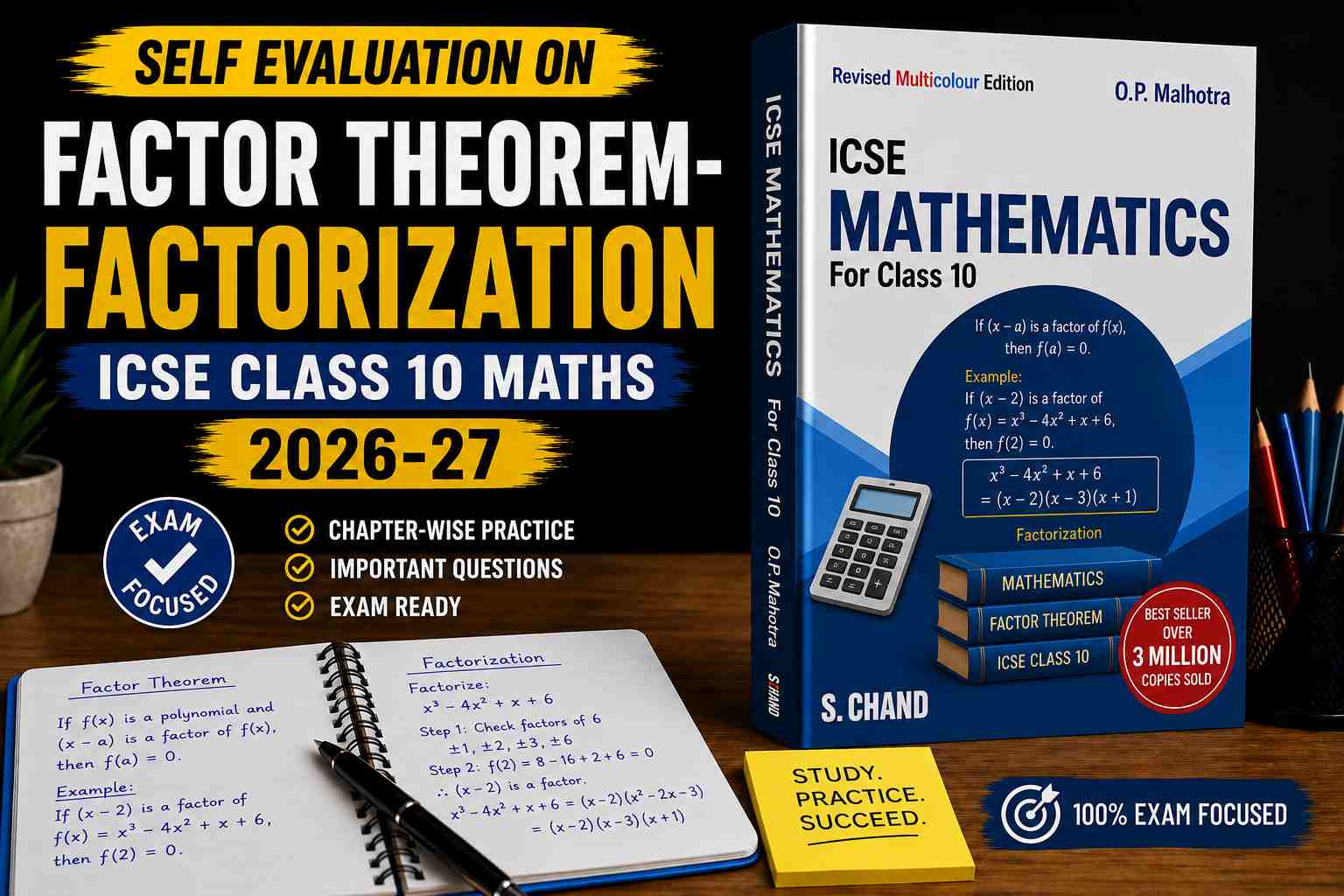


Self Evaluation on Factor Theorem-Factorization ICSE Class 10 Maths OP Malhotra (2026-27)
| Board | ICSE |
| Publications | S Chand |
| Subject | Maths |
| Class | 10th |
| Chapter-7 | Factor Theorem-Factorization |
| Writer | OP Malhotra |
| Self Evaluation | Extra Practice Questions |
| Edition | 2026-2027 |
Self Evaluation on Factor Theorem-Factorization
Self Evaluation on Factor Theorem-Factorization ICSE Class 10 Maths OP Malhotra (2026-27)
Q.1 Find the remainder when 2x³ − 3x² + 7x − 8 is divided by x − 1.
Sol: Let f(x) = 2x³ − 3x² + 7x − 8
By the Remainder Theorem,
Remainder = f(1)
f(1) = 2(1)³ − 3(1)² + 7(1) − 8
= 2 − 3 + 7 − 8
= −2
Answer: Remainder = −2
Q.2 Find the values of a and b if (x − 2) and (x + 3) are factors of x³ + ax² + bx − 12.
Sol: Let f(x) = x³ + ax² + bx − 12
Since (x − 2) is a factor,
f(2) = 0
8 + 4a + 2b − 12 = 0
4a + 2b = 4
2a + b = 2 …….. (1)
Since (x + 3) is a factor,
f(−3) = 0
⇒−27 + 9a − 3b − 12 = 0
⇒9a − 3b = 39
⇒3a − b = 13 …….. (2)
Adding (1) and (2),
5a = 15
a = 3
Substituting in (1),
2(3) + b = 2
b = −4
Answer: a = 3, b = −4
Q.3 Using Factor Theorem, show that (x − 3) is a factor of x³ − 7x² + 15x − 9. Hence factorise completely.
Sol: f(x) = x³ − 7x² + 15x − 9
f(3) = 27 − 63 + 45 − 9
= 0
Therefore, (x − 3) is a factor.
Dividing f(x) by (x − 3), we get:
x² − 4x + 3
Factorising further,
x² − 4x + 3 = (x − 3)(x − 1)
Hence,
f(x) = (x − 3)(x − 3)(x − 1)
Answer: (x − 3)²(x − 1)
Q.4 Find the value of a, if (x − a) is a factor of x³ − a²x + x + 2.
Sol: f(x) = x³ − a²x + x + 2
Since (x − a) is a factor,
f(a) = 0
a³ − a³ + a + 2 = 0
a + 2 = 0
a = −2
Answer: a = −2
Q.5 Use the Factor Theorem to factorise completely: x³ + x² − 4x − 4.
Sol: f(x) = x³ + x² − 4x − 4
f(−1) = (−1)³ + (−1)² − 4(−1) − 4
= −1 + 1 + 4 − 4
= 0
Therefore, (x + 1) is a factor.
Dividing by (x + 1),
x² − 4
x² − 4 = (x + 2)(x − 2)
Hence,
x³ + x² − 4x − 4 = (x + 1)(x + 2)(x − 2)
Answer: (x + 1)(x + 2)(x − 2)
Q.6 (x − 2) is a factor of x³ + ax² + bx + 6. When divided by (x − 3), it leaves a remainder 3. Find a and b.
Sol: f(x) = x³ + ax² + bx + 6
Since (x − 2) is a factor,
f(2) = 0
8 + 4a + 2b + 6 = 0
4a + 2b = −14
2a + b = −7 …….. (1)
Since remainder on division by (x − 3) is 3,
f(3) = 3
27 + 9a + 3b + 6 = 3
9a + 3b = −30
3a + b = −10 …….. (2)
Subtracting (1) from (2),
a = −3
Substituting in (1),
2(−3) + b = −7
b = −1
Answer: a = −3, b = −1
Q.7 Show that 2x + 7 is a factor of 2x³ + 5x² − 11x − 14. Hence factorise the given expression completely using Factor Theorem.
Sol: f(x) = 2x³ + 5x² − 11x − 14
f(−7/2) = 2(−7/2)³ + 5(−7/2)² − 11(−7/2) − 14
= −343/4 + 245/4 + 77/2 − 14
= −98/4 + 154/4 − 56/4
= 0
Therefore, (2x + 7) is a factor.
Dividing by (2x + 7), we get
x² − x − 2
x² − x − 2 = (x − 2)(x + 1)
Hence,
2x³ + 5x² − 11x − 14 = (2x + 7)(x − 2)(x + 1)
Answer: (2x + 7)(x − 2)(x + 1)
Q.8 Show that (x − 1) is a factor of x³ − 7x² + 14x − 8. Hence completely factorise the above expression.
Sol: f(x) = x³ − 7x² + 14x − 8
f(1) = 1 − 7 + 14 − 8 = 0
Therefore, (x − 1) is a factor.
Dividing by (x − 1), we get
x² − 6x + 8
x² − 6x + 8 = (x − 2)(x − 4)
Hence,
x³ − 7x² + 14x − 8 = (x − 1)(x − 2)(x − 4)
Answer: (x − 1)(x − 2)(x − 4)
Q.9 If (x − 2) is a factor of 2x³ − x² − px − 2:
(i) Find the value of p.
(ii) With the value of p, factorise the above expression completely.
Sol:
f(x) = 2x³ − x² − px − 2
Since (x − 2) is a factor,
f(2) = 0
16 − 4 − 2p − 2 = 0
10 − 2p = 0
p = 5
Substituting p = 5,
f(x) = 2x³ − x² − 5x − 2
Dividing by (x − 2), we get
2x² + 3x + 1
2x² + 3x + 1 = (2x + 1)(x + 1)
Hence,
2x³ − x² − 5x − 2 = (x − 2)(2x + 1)(x + 1)
Answer: p = 5 and (x − 2)(2x + 1)(x + 1)
Q.10 Given that x + 2 and x + 3 are factors of 2x³ + ax² + 7x − b, determine the values of a and b.
Sol: f(x) = 2x³ + ax² + 7x − b
Since (x + 2) is a factor,
f(−2) = 0
−16 + 4a − 14 − b = 0
4a − b = 30 …….. (1)
Since (x + 3) is a factor,
f(−3) = 0
−54 + 9a − 21 − b = 0
9a − b = 75 …….. (2)
Subtracting (1) from (2),
5a = 45
a = 9
Substituting in (1),
36 − b = 30
b = 6
Answer: a = 9, b = 6
Q.11 When divided by x − 3, the polynomials x³ − px² + x + 6 and 2x³ − x² − (p + 3)x − 6 leave the same remainder. Find the value of p.
Sol :Let
f(x) = x³ − px² + x + 6
g(x) = 2x³ − x² − (p + 3)x − 6
Since both leave the same remainder when divided by (x − 3),
f(3) = g(3)
⇒27 − 9p + 3 + 6 = 54 − 9 − 3(p + 3) − 6
⇒36 − 9p = 39 − 3p
⇒−6p = 3
p = −1/2
Answer: p = −1/2
Q.12 Use the Remainder Theorem to factorise the following expression: 2x³ + x² − 13x + 6.
Sol: f(x) = 2x³ + x² − 13x + 6
f(2) = 16 + 4 − 26 + 6 = 0
Therefore, (x − 2) is a factor.
Dividing by (x − 2), we get
2x² + 5x − 3
2x² + 5x − 3 = (2x − 1)(x + 3)
Hence,
2x³ + x² − 13x + 6 = (x − 2)(2x − 1)(x + 3)
Answer: (x − 2)(2x − 1)(x + 3)
Q.13 Find the value of k if (x − 2) is a factor of x³ + 2x² − kx + 10. Hence determine whether (x + 5) is also a factor.
Sol:f(x) = x³ + 2x² − kx + 10
Since (x − 2) is a factor,
f(2) = 0
8 + 8 − 2k + 10 = 0
26 − 2k = 0
k = 13
Substituting k = 13,
f(x) = x³ + 2x² − 13x + 10
Now,
f(−5) = (−5)³ + 2(−5)² − 13(−5) + 10
= −125 + 50 + 65 + 10
= 0
Therefore, (x + 5) is also a factor.
Answer: k = 13 and (x + 5) is also a factor.
Q.14 Using the Remainder Theorem, factorise completely the polynomial: 3x³ + 2x² − 19x + 6.
Sol:f(x) = 3x³ + 2x² − 19x + 6
f(2) = 24 + 8 − 38 + 6 = 0
Therefore, (x − 2) is a factor.
Dividing by (x − 2), we get
3x² + 8x − 3
3x² + 8x − 3 = (3x − 1)(x + 3)
Hence,
3x³ + 2x² − 19x + 6 = (x − 2)(3x − 1)(x + 3)
Answer: (x − 2)(3x − 1)(x + 3)
Q.15 If (x − 2) is a factor of the expression 2x³ + ax² + bx − 14 and when the expression is divided by (x − 3), it leaves a remainder 52, find the values of a and b.
Sol: f(x) = 2x³ + ax² + bx − 14
Since (x − 2) is a factor,
f(2) = 0
16 + 4a + 2b − 14 = 0
4a + 2b = −2
2a + b = −1 …….. (1)
Since the remainder on division by (x − 3) is 52,
f(3) = 52
54 + 9a + 3b − 14 = 52
9a + 3b = 12
3a + b = 4 …….. (2)
Subtracting (1) from (2),
a = 5
Substituting in (1),
10 + b = −1
b = −11
Answer: a = 5, b = −11
Q.16 Using Remainder and Factor Theorem, factorise the polynomial: x³ + 10x² − 37x + 26.
Sol: f(x) = x³ + 10x² − 37x + 26
f(1) = 1 + 10 − 37 + 26 = 0
Therefore, (x − 1) is a factor.
Dividing by (x − 1), we get
x² + 11x − 26
x² + 11x − 26 = (x + 13)(x − 2)
Hence,
x³ + 10x² − 37x + 26 = (x − 1)(x + 13)(x − 2)
Answer: (x − 1)(x − 2)(x + 13)
Q.17 Find ‘a’ if the two polynomials ax³ + 3x² − 9 and 2x³ + 4x + a leave the same remainder when divided by x + 3.
Sol: Let
f(x) = ax³ + 3x² − 9
g(x) = 2x³ + 4x + a
Since both leave the same remainder when divided by (x + 3),
f(−3) = g(−3)
⇒−27a + 27 − 9 = −54 − 12 + a
⇒−27a + 18 = a − 66
⇒84 = 28a
a = 3
Answer: a = 3
Q.18 Using Remainder Theorem, find the value of k if on dividing 2x³ + 3x² − kx + 5 by x − 2, it leaves a remainder 7.
Sol: f(x) = 2x³ + 3x² − kx + 5
By the Remainder Theorem,
f(2) = 7
⇒16 + 12 − 2k + 5 = 7
⇒33 − 2k = 7
⇒−2k = −26
k = 13
Answer: k = 13
Very Short Answer Type Questions (VSA) – Solutions
Q.1 The remainder when x³ + 5x − 7 is divided by (x − 1) is ___ .
Sol: Let f(x) = x³ + 5x − 7
By the Remainder Theorem,
Remainder = f(1)
f(1) = 1³ + 5(1) − 7
= 1 + 5 − 7
= −1
Answer: −1
Q.2 Is (x + 1) a factor of x² − 10x − 11? Yes / No.
Sol: Let f(x) = x² − 10x − 11
f(−1) = (−1)² − 10(−1) − 11
= 1 + 10 − 11
= 0
Therefore, (x + 1) is a factor.
Answer: Yes
Q.3 Find the value of k if (3x + 2) is a factor of 9x² − k.
Sol: Let f(x) = 9x² − k
Since (3x + 2) is a factor,
f(−2/3) = 0
9(−2/3)² − k = 0
9 × 4/9 − k = 0
4 − k = 0
k = 4
Answer: k = 4
Q.4 Find p(0), p(1) and p(−2) if p(x) = 10x − 4x² − 3.
Sol: p(0) = 10(0) − 4(0)² − 3 = −3
p(1) = 10(1) − 4(1)² − 3
= 10 − 4 − 3
= 3
p(−2) = 10(−2) − 4(−2)² − 3
= −20 − 16 − 3
= −39
Answer: p(0) = −3, p(1) = 3, p(−2) = −39
Q.5 For what value of m is x³ − 2mx² + 16 divisible by x + 2?
Sol: Let f(x) = x³ − 2mx² + 16
Since (x + 2) is a factor,
f(−2) = 0
(−2)³ − 2m(−2)² + 16 = 0
−8 − 8m + 16 = 0
8 − 8m = 0
m = 1
Answer: m = 1
Q.6 If x + 1 is a factor of ax³ + x² − 2x + 4a − 9, find the value of a.
Sol: Let f(x) = ax³ + x² − 2x + 4a − 9
Since (x + 1) is a factor,
f(−1) = 0
−a + 1 + 2 + 4a − 9 = 0
3a − 6 = 0
a = 2
Answer: a = 2
Q.7 By Remainder Theorem, find the remainder when p(x) is divided by q(x), given that p(x) = 4x³ − 12x² + 14x − 3, q(x) = 2x − 1.
Sol: Since q(x) = 2x − 1,
2x − 1 = 0
x = 1/2
Remainder = p(1/2)
= 4(1/2)³ − 12(1/2)² + 14(1/2) − 3
= 1/2 − 3 + 7 − 3
= 3/2
Answer: 3/2
Q.8 Check whether p(x) is a multiple of q(x) or not, given that p(x) = x³ − 5x² + 4x − 3, q(x) = x − 2.
Sol: For p(x) to be a multiple of q(x), (x − 2) must be a factor.
p(2) = 2³ − 5(2)² + 4(2) − 3
= 8 − 20 + 8 − 3
= −7
Since p(2) ≠ 0, (x − 2) is not a factor.
Answer: No
Q.9 The polynomial p(x) = x⁴ − 2x³ + 3x² − ax + 3a − 7 when divided by x + 1 leaves the remainder 19. Find the value of a.
Sol: Since the divisor is (x + 1),
p(−1) = 19
⇒ 1 + 2 + 3 + a + 3a − 7 = 19
⇒ 4a − 1 = 19
⇒ 4a = 20
a = 5
Answer: a = 5
Q.10 If both x − 2 and x − 1/2 are factors of px² + 5x + r, show that p = r.
Sol: Let f(x) = px² + 5x + r
Since (x − 2) is a factor,
f(2) = 0
4p + 10 + r = 0 …….. (1)
Since (x − 1/2) is a factor,
f(1/2) = 0
p/4 + 5/2 + r = 0
Multiplying by 4,
p + 10 + 4r = 0 …….. (2)
Subtracting (2) from (1),
⇒ 4p + r − p − 4r = 0
⇒ 3p − 3r = 0
⇒ p = r
Answer: p = r
Multiple Choice Questions (MCQs) – Solutions
Q.1 If x + 1 is a factor of the polynomial 2x² + kx, then value of k is
Sol: Let f(x) = 2x² + kx
Since (x + 1) is a factor,
f(−1) = 0
⇒ 2(−1)² + k(−1) = 0
⇒ 2 − k = 0
k = 2
Answer: (c) 2
Q.2 If (x + 3) is a factor of x³ + 3x² + 4x + k, then what is the value of k?
Sol: Let f(x) = x³ + 3x² + 4x + k
Since (x + 3) is a factor,
f(−3) = 0
⇒ −27 + 27 − 12 + k = 0
k = 12
Answer: (a) 12
Q.3 If 5x³ + 5x² − 6x + 9 is divided by (x + 3), then the remainder is
Sol: Let f(x) = 5x³ + 5x² − 6x + 9
Remainder = f(−3)
= 5(−3)³ + 5(−3)² − 6(−3) + 9
= −135 + 45 + 18 + 9
= −63
Answer: (d) −63
Q.4 If (x + 2) is a common factor of x² + ax + b and x² + bx + a, then the ratio a : b is equal to
Sol: Since (x + 2) is a factor of both polynomials,
4 − 2a + b = 0 …….. (1)
4 − 2b + a = 0 …….. (2)
Subtracting (2) from (1),
−3a + 3b = 0
a = b
Therefore,
a : b = 1 : 1
Answer: (a) 1
Q.5 (x + 4) is a factor of which one of the following expressions?
(a) x² − 7x + 44
(b) x² + 7x − 44
(c) x² − 7x − 44
(d) x² + 7x + 44
Sol: For option (c),
f(−4) = (−4)² − 7(−4) − 44
= 16 + 28 − 44
= 0
Hence (x + 4) is a factor of option (c).
Answer: (c) x² − 7x − 44
Q.6 If x⁵ + 51 is divided by x + 1, the remainder is
Sol: Let f(x) = x⁵ + 51
Remainder = f(−1)
= (−1)⁵ + 51
= −1 + 51
= 50
Answer: (d) 50
Q.7 If p(x) = x² − 4x + 3, evaluate p(2) − p(−1) + p(1/2).
Sol: p(2) = 4 − 8 + 3 = −1
p(−1) = 1 + 4 + 3 = 8
p(1/2) = 1/4 − 2 + 3
= 5/4
Therefore,
p(2) − p(−1) + p(1/2)
= −1 − 8 + 5/4
= −36/4 + 5/4
= −31/4
Answer: (c) −31/4
Q.8 Which one of the following is correct?
(a) (x + 2) is a factor of x⁴ − 6x³ + 12x² − 24x + 32
(b) (x + 2) is a factor of x⁴ + 6x³ − 12x² + 24x − 32
(c) (x − 2) is a factor of x⁴ − 6x³ + 12x² − 24x + 32
(d) (x − 2) is a factor of x⁴ + 6x³ − 12x² + 24x − 32
Sol: Checking option (c):
f(2) = 2⁴ − 6(2³) + 12(2²) − 24(2) + 32
= 16 − 48 + 48 − 48 + 32
= 0
Therefore, (x − 2) is a factor.
Answer: (c)
Q.9 If (x + k) is the common factor of x² + ax + b and x² + cx + d, then what is k equal to?
Sol: Since (x + k) is a common factor,
k² − ak + b = 0 …….. (1)
k² − ck + d = 0 …….. (2)
Subtracting (2) from (1),
−ak + ck + b − d = 0
k(c − a) = d − b
k = (d − b)/(c − a)
Answer: (a) (d − b)/(c − a)
Q.10 x³ + 6x² + 11x + 6 is divisible by
(a) only (x + 1)
(b) only (x + 2)
(c) only (x + 3)
(d) All of the above
Sol: f(x) = x³ + 6x² + 11x + 6
f(−1) = 0
f(−2) = 0
f(−3) = 0
Hence,
x³ + 6x² + 11x + 6 = (x + 1)(x + 2)(x + 3)
Therefore, it is divisible by all three factors.
Answer: (d) All of the above
— : End of Self Evaluation on Factor Theorem-Factorization ICSE Class 10 Maths OP Malhotra (2026-27) :–
Return to :– OP Malhotra S Chand Solutions for ICSE Class-10 Maths
Thanks
Please Share with Your Friends