Nervous System Class 10 Concise Structured/Applications/Skill Type Answer ICSE Biology Selina Solutions Ch-10. In this article you will get the solutions of Structured/Applications/Skill Type Type Questions as council latest syllabus. Visit official website CISCE for detail information about ICSE Board Class-10 Biology.
Nervous System Class 10 Concise Structured/Applications/Skill Type Answer ICSE Biology Selina Solutions Ch-10
| Board | ICSE |
| Subject | Biology |
| Class | 10 |
| Book | Selina Concise |
| Chapter-10 | Nervous System |
| Topics | Solutions of Structured/Applications/Skill Type Type Questions |
Structured/Applications/Skill Type Type Questions on Nervous System
Que-1: Two hungry boys (A and B) enter a restaurant and see the menu. Boy B starts salivating but not A. Explain the reason for this difference.
Ans:
Salivation is an example of conditioned reflex that develops due to experience or learning. Saliva starts pouring when you chew or eat food. Therefore, this reflex will occur not just on the sight or smell of food. The brain actually needs to remember the taste of food. Boy B started salivating because he must have tasted that food prior unlike boy A.
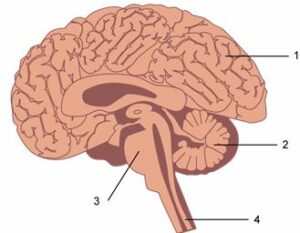
Que-2: The diagram alongside shows a section of the human brain and its associated parts. Answer the questions that follow:
(a) Name the parts labelled 1, 2, 3 and 4.
(b) Name the protective membranous covering of the brain. Also mention its three layers.
(c) Name the basic unit of the brain.
(d) Write the important role of the part mentioned as 2.
Ans:
(a) 1 – Cerebrum, 2 – Cerebellum, 3 – Pons, 4 – Medulla oblongata.
(b) Meninges. The three layers of meninges are dura mater, arachnoid and pia mater.
(c) Neuron/nerve cell.
(d) Cerebellum (part 2) coordinates muscular activity and balance of the body.
Que-3: The diagram given below shows the internal structure of spinal cord depicting a phenomenon. Study the diagram and answer the following questions.
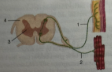
(a) Name the phenomenon shown in the figure and define the same.
(b) Identify the parts labelled as 1 and 2. Write one functional difference between these two.
(c) Name the bony protective covering and the membranous protective covering of the spinal cord.
(d) Label the guidelines 3 and 4.
(e) How is the labelled part 3 different from part 4 with respect to its composition (part of neuron)?
(f) Give the technical term for the point of contact between the two nerve cells.
(g) Name the fluid filled inside the central canal of spinal cord.
(h) Name the term used for a small gap between two neurons.
(i) Give one example of a neurotransmitter.
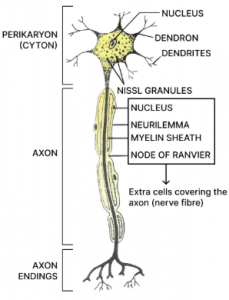
(j) Draw a neat diagram of a nerve cell and label the parts : Perikaryon, Node of Ranvier, Myelin sheath and Axon terminals.
Ans:
(a) The phenomenon shown in the figure is Spinal reflex.
Spinal reflex is an automatic/quick/immediate, involuntary action in the body brought about by a stimulus.
(b) The parts labelled 1 & 2 are:
1 → Sensory nerve
2 → Motor nerve
One functional difference between Sensory & Motor nerve is:
| Sensory nerve | Motor nerve |
|---|---|
| Brings impulse from receptors to brain or spinal cord. | Carry impulse from brain and spinal cord to effector organs. |
(c) Back bone or vertebral column is the bony protective covering. Meninges (dura mater, arachnoid and pia mater) is the membranous protective covering.
(d) Guidelines 3 and 4 are:
3 → Gray matter
4 → White matter
(e) Gray matter is composed of cytons and white matter is composed of axons.
(f) Synapse
(g) Cerebrospinal fluid
(h) Synapse
(i) Acetylcholine
(j) Diagram of nerve cell with the parts labelled is shown below:
Que-4: The figure given below is the basic structural and functional unit of the human nervous system. Study the diagram and answer the following questions:
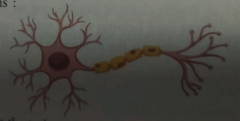
(a) Write the technical term for the diagram.
(b) Name two organs of our nervous system where these cells are richly found.
(c) How are these cells significant for us ?
(d) Name the cell organelle that is absent in these cells and how does it affect our body metabolism ?
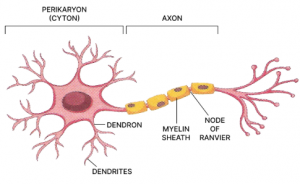
(e) Redraw the same figure and label the following — Perikaryon, Axon, Dendrites, Myelin sheath and Node of Ranvier.
Ans:
(a) Neuron
(b) Brain and spinal cord
(c) Neurons are the fundamental building blocks of the nervous system. They help us to process information, control our movements, allow us to perceive the world around us, and are involved in learning and memory.
(d) Centrosome is the cell organelle absent in these cells. It is absent because the nerve cells have lost the ability to divide.
(e) Below is the labelled diagram of neuron:
Que-5: It was a pleasant dark evening when Anuj saw a person clumsily walking towards him. The person, in his nonsensical and slurred speech, started talking to Anuj and Anuj realised he was possibly intoxicated. Answer the following questions:
(a) How does alcohol consumption affect the brain ? State the part of the brain affected resulting in uncoordinated movements and speech.
(b) In which part of the brain does the impulse for walking or speaking arise ?
(c) How does part (a) differ with part (b) structurally?
Ans:
(a) Alcohol slows down brain activity, which leads to delayed responses, poor coordination and slower thinking. It also affects hippocampus part of brain which can lead to blackouts.
The part of brain which is affected resulting in uncoordinated movements and speech is Cerebellum.
(b) Cerebrum
(c) Differences between Cerebellum and Cerebrum:
| Cerebellum | Cerebrum |
|---|---|
| It is a small, egg-shaped lobe located at the base under the cerebrum. | It is the uppermost, largest and the most prominent part of the brain. |
| It does not have convolutions, but has many furrows. | It is highly convoluted in appearance with ridges and grooves. |
| It coordinates the movement of voluntary muscles and maintains the balance of the body. | It controls mental activities such as thinking and reasoning, memory, intelligence and perception of taste, pain and touch etc. |
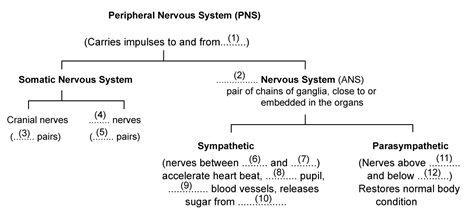
Que-6: Given below is the partially incomplete scheme of the components of peripheral nervous system. Fill up the blanks numbered (1)- (12):
Ans:
Fill in the following information in the diagram.
- Central Nervous System
- Autonomic
- 12
- Spinal
- 31
- Neck
- Waist
- dilates
- constricts
- liver
- neck
- sacral
–: End of Nervous System Class 10 Concise Structured/Applications/Skill Answer ICSE Biology Selina Solutions :–
Return to : Concise Biology for ICSE Class 10 Selina Solutions
Please share with your Friends if helpful
Thanks