Sense Organs Class 10 Concise Short Answer ICSE Biology Selina Solutions Ch-11. In this article you will get the solutions of Short Answer Questions on Sense Organs. Visit official website CISCE for detail information about ICSE Board Class-10 Biology.
Sense Organs Class 10 Concise Short Answer ICSE Biology Selina Solutions Ch-11
| Board | ICSE |
| Subject | Biology |
| Class | 10 |
| Book | Selina Concise |
| Chapter-11 | Sense Organs |
| Topics | Solutions of Short Questions |
Short Answer Type Questions on Sense Organs
Page 149
Que-1: State whether the following statements are true (T) or false (F). If false, correct it by changing any one single word.
(a) Deafness is caused due to rupturing of the pinna.(T/F)
(b) Semicircular canals are concerned with static (positional) balance. (T/F)
Ans:
((a) False
Correct statement : Deafness is caused due to rupturing of the eardrum.
(b) False
Correct statement : Semicircular canals are concerned with dynamic balance.
Que-2: Where are the following located? State their main functions :
(a) Yellow spot
(b) Lacrimal gland
(c) Organ of Corti
(d) Semicircular canal
(e) Oval window
(f) Utriculus
Ans:
(a) Yellow spot : lies at the back of the eye almost at the centre on the horizontal axis of the eyeball. It is the region of brightest vision and also of colour vision.
(b) Lacrimalglands : are located at the upper sideward portion of the eye orbit. They pour the secretion in the form of tears which serves as a lubricant, antiseptic and even washes away dust particles from the eyes.
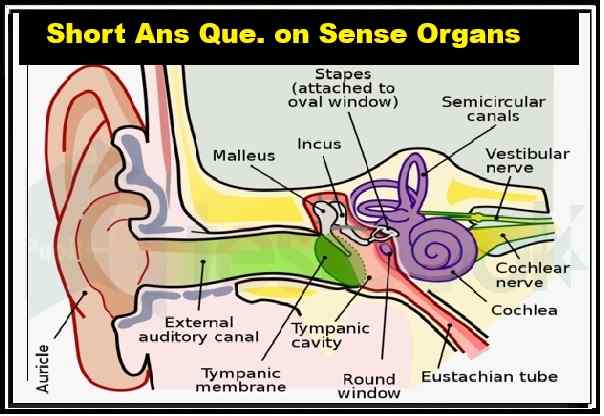
(c) rgan ofCorti : is present in the middle cochlear canal of the ear. It helps in hearing.
(d) Semicircular : canals are located in the inner ear. These help in maintaining the dynamic equilibrium of the body.
(e) Ovalwindow : is located in the middle ear. It helps in setting the fluid in the cochlear canals into vibration.
(f) Utriculus : is located in the inner ear. It joins the semi-circular canals to cochlea. It also helps in maintaining static balance of the body.
Que-3: Given below are two sets (a) and (b) of five parts in each. Rewrite them in correct sequence.
(a) Cochlea, tympanum, auditory canal, ear ossicles, oval window
(b) Conjunctiva, retina, cornea, optic nerve, lens
Ans:
(a) Auditory canal, tympanum, ear ossicles, oval window, cochlea
(b) Conjunctiva, cornea, lens, retina, optic nerve
Que-4: Write the main functional activity of each of the following structures.
(a) Cochlea
(b) Semicircular canal
(c) Iris
(d) Choroid
(e) Ciliary body and suspensory ligament
Ans:
(a) Cochlea : Cochlea contains organ of Corti which contains sensory cells for hearing. They transmit sound impulses to the brain through auditory nerve.
(b) Semicircular canal: Dynamic Equilibrium.
(c) Iris: Regulates the size of pupil controlling the amount of light entering the eyes.
(d) Choroid : It is middle vascular layer of the eyeball. Choroid provides nourishment to the eye.
(e) Ciliary body and suspensory ligament: Accommodation of eye.
Que-5: Complete the following table by filling in the blank spaces.
| Structure | Function |
| 1. ……………………. | (i) Transfers impulse from inner ear to brain |
| 2. ……………………. | (ii) Helps to change the focal length of the eye lens |
| 3. ……………………. | (iii) Dynamic equilibrium |
Ans:
Complete the following table by filling in the blank spaces.
| Structure | Function |
| 1. Auditory nerve | (i) Transfers impulse from inner ear to brain |
| 2. Ciliary muscle | (ii) Helps to change the focal length of the eye lens |
| 3. semicircular canals | (iii) Dynamic equilibrium |
Que-6: Name the following:
(a) Two pigments of the sensory cells.
(b) Two types of adaptations.
(c) Two kinds of accommodations.
(d) Three layers of the eyeball.
Ans:
(a) Rhodopsin and iodopsin.
(b) Dark adaptation and light adaptation.
(c) Distant vision accommodation and near vision accommodation.
(d) Sclera, choroid and retina.
Que-7: Name the eye defects caused due to each of the following:
| Cause | Eye defect |
| (a) Lens turns opaque | ……………………….. |
| (b) Uneven curvature of the cornea | ……………………….. |
| (c) Deficiency of vitamin A | ……………………….. |
| (d) Lens loses its flexibility | ……………………….. |
| (e) Eye ball lengthens from front to back | ……………………….. |
| (f) Lens becomes too flat | ……………………….. |
Ans:
| Cause | Eye defect |
| (a) Lens turns opaque | Cataract |
| (b) Uneven curvature of the cornea | Astigmatism |
| (c) Deficiency of vitamin A | Night blindness |
| (d) Lens loses its flexibility | Presbyopia |
| (e) Eye ball lengthens from front to back | Myopia |
| (f) Lens becomes too flat | Hyperopia |
–: End of Sense Organs Class 10 Concise Short Answer ICSE Biology Selina Ch-11 important Questions :–
Return to : Concise Biology for ICSE Class 10 Selina Solutions
Please share with your Friends if helpful
Thanks