
Progress Check of Sense Organs Class 10 Concise ICSE Biology Selina Solutions Ch-11. In this article you will get the solutions / answer of Progress Check 1 and 2 Questions / problems . Visit official website CISCE for detail information about ICSE Board Class-10 Biology.
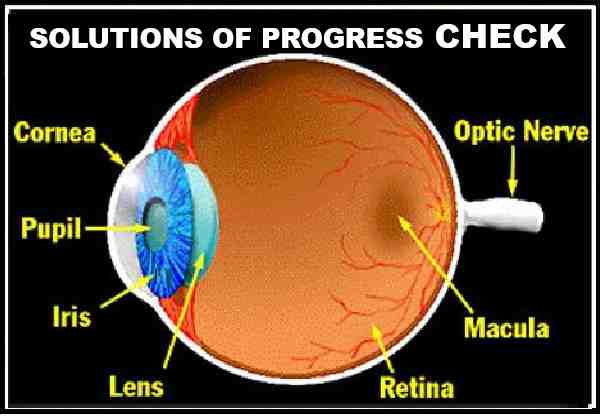
Solutions of Progress Check Questions of Sense Organs Class 10 Concise ICSE Biology Selina Solutions Ch-11
| Board | ICSE |
| Subject | Biology |
| Class | 10 |
| Book | Selina Concise |
| Chapter-11 | Sense Organs |
| Topics | Solutions of Progress Check 1 and 2 Questions |
Progress Check-1 Questions
Class 10 Concise ICSE Biology Selina Solutions Ch-11 Sense Organs
Que-1: State the functions of the following :
(i) Eyelids
(ii) Eyelashes
(iii) Tears
(iv) Iris
(v) Ciliary muscles
Ans:
(i) Eyelids : They protect the front of the eyes and shut out the light entering into the eye.
(ii) Eyelashes : They prevent the falling of large particles into the eye.
(iii) Tears : Tears help in washing away the dust particles in our eye.
(iv) Iris : The thin and circular iris of the eye is responsible for controlling the diameter and size of the pupil and thus, the amount of light reaching the retina.
(v) Ciliary muscles : The ciliary muscle fibers in the eyes enable change in the lens shape for focusing light falling on the eyes.
Que-2: Write in proper sequence the names of all the parts of the human eye through which the light rays coming from an object pass before they form an image on the retina.
Ans:
The parts of the human eye through which the light rays coming from an object pass before they form an image on the retina are
When light rays come from an object, the light first enters the cornea which is a thin membrane present on the front surface of the eyeball. Iris is present behind the cornea which controls the size of the pupil. The pupil regulates and controls the amount of light entering the eye. The eye lens forms an inverted real image of the object on the retina which contain number of light sensitive cells . These light sensitive cells get activated upon illumination and generate electrical signals. These signals are sent to the brain via the optic nerves. The brain interprets these signals and processes the information that we perceive.
Que-3: Name the following :
(i) Place of best vision in the retina of the eye
(ii) Place of no vision in the retina of the eye
(iii) Kind of retinal cells sensitive to dim light
(iv) The circular opening enclosed by iris
(v) The fibres which collectively hold the lens in position
(vi) Capacity of the eye to focus at different distances
(vii) The kind of lens required to correct near sightedness
(vi) The layer of the wall of the eye-ball that corresponds to the black lining of the box of a camera
Ans:
(i) Yellow Spot
(ii) Blind Spot
(iii) Rods
(iv) Pupil
(v) Suspensory ligaments
(vi) Accommodation
(vii) Concave lens
(viii) Choroid layer
Que-4: Give the reason for the following :
(i) Medicines dropped in the eye flow down into the nose
(ii) A person from bright sunlight outside enters a poorly lit room and feels blinded for a short while
Ans:
(i) When medicine is dropped into the eyes, it passes into the back of the nose via the lacrimal punctum that leads to the nasolacrimal duct. This is the duct that connects the nose to the eyes.
(ii) When one enters a dim lit room with bright sunlight, it takes some time to see the objects. This is due to the fact that in bright sunlight the pupil of our eye is in the contracted form. So, when we enter the dim lit room, very little light enters our eye and we are unable to see properly. After a short time, the pupil of our eye expands or dilates and becomes large. Regeneration of rhodopsin leads to more light then entering the eye and we can see clearly.
Progress Check-2
Sense Organs ICSE Progress Check Class-10 Concise Selina Biology
Page 147-148
Que-1: Categorise the following parts under (i) external, (ii) middle and (iii) internal ear.
Ear drum, hammer, pinna, cochlea, anvil, stirrup, eustachian tube, tympanum, oval window, semi-circular canals.
Ans:
(i) External ear : Pinna, Eardrum, Tympanum
(ii) Middle ear : Hammer, Anvil, Stirrup, Oval window, Eustachian tube
(iii) Internal ear : Semi-circular canals, Cochlea
Que-2: State the functions of the following :-
(i) Semi-circular canals
(ii) Cochlea
(iii) Auditory nerve
Ans:
(a) These are filled with fluid and are attached to cochlea and nerves. They send information on balance and head position to the brain.
(b) Cochlea is a spiral-shaped organ of hearing which transforms sound into signals that get sent to the brain.
(c) It drains the fluid from the middle ear into the throat behind the nose.
Que-3: Mention if the following statements are true (T) or false (F)
(i) Human ear is concerned with hearing only. T/F
(ii) Pinna concentrates and directs sound waves towards tympanum. T/F
Ans:
(i) False – Human ear is concerned with hearing and balancing.
(ii) True – Pinna increase area
Que-4: Given below is a diagrammatic representation of a part of the human ear.
(i) Name the parts numbered 1-6.
(ii) Which parts of the ear shown here are complete.
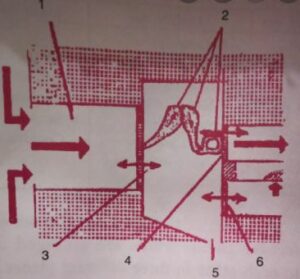
Ans:
(i)
1- Auditory canal
2- Ear ossicles (hammer, anvil, stirrup)
3- Ear drum or Tympanum
4- Oval window
5- The opening of the Eustachian tube
6- Round window
(ii) The part of the ear that is shown here in complete is the middle ear.
–: End of Progress Check of Sense Organs Class 10 Concise ICSE Biology Selina Ch-11 solutions :–
Return to : Concise Biology for ICSE Class 10 Selina Solutions
Please share with your Friends if helpful
Thanks

1 thought on “Progress Check of Sense Organs Class 10 Concise ICSE Biology Selina Solutions”
This helped me so much actually. Thank you 🤍