Chemical Bonding Intex-2 Concise Class-10 ICSE Chemistry Selina Solutions Ch-2. We Provide Step by Step Answer of Intext-2, Exercise-2, ICSE Class-10. The given Solutions is according to the Latest editions. Visit official Website CISCE for detail information about ICSE Board Class-10.


Chemical Bonding Intex-2 Concise Class-10 ICSE Chemistry Selina Solutions Ch-2
| Board | ICSE |
| Book / Publication | Concise / Selina |
| Subject | Chemistry |
| Class | 10th |
| Writer | Dr SP Singh |
| Chapter-2 | Chemical Bonding |
| Topics | Intext -2 |
| Edition | 2025-2026 |
Ch-2 Chemical Bonding Intex-2 Questions
Page-32
Que-1: What are conditions necessary for the formation of covalent molecules?
Ans:
(i) Both atoms should have four or more electrons in their outermost shells, i.e., non-metals.
(ii) Both the atoms should have high electronegativity.
(iii) Both the atoms should have high electron affinity and high ionisation potential.
(iv) Electronegativity difference between the two atoms should be zero or negligible.
(v) The approach of the atoms towards one another should be accompanied by decrease of energy.
Que-2: Elements A, B and C have atomic numbers 17, 19 and 10 respectively.
(a) State which one is:
(i) A non-metal
(ii) A metal
(iii) Chemically inert?
(b) Write down the formula of the compound formed by two of the above elements.
Ans:
(a) A is a non-metal; B is a metal while C is a chemically inert element.
(b) BA
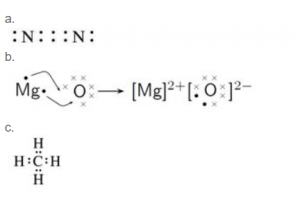
Que-3: Draw the electron dot diagram and structure of:
(a) nitrogen molecule
(b) magnesium chloride
(c) methane
Ans:
Que-4: What is the difference between:
(a) Ionic compounds and polar covalent compounds
(b) Ionic compounds and covalent compounds
(c) A polar covalent compound and a non-polar covalent compound?
Ans:
(a) difference between Ionic compounds and polar covalent compounds
Ionic compounds are formed as a result of the transfer of one or more electrons from the atom of a metallic electropositive element to an atom of a non-metallic electronegative element.
A polar covalent compound is the one in which there is an unequal distribution of electrons between the two atoms.
(b) difference between Ionic compounds and covalent compounds
Ionic compounds, made up of ions, are generally crystalline solids with high melting and boiling points.
They are soluble in water and good conductors of electricity in aqueous solution and molten state.
Covalent compounds, made up of molecules, can exist as soft solids or liquids or gases with low melting and boiling points. They are generally insoluble in water and poor conductors of electricity.
(c) difference between Ionic Polar covalent and Non-polar compounds
Polar covalent compounds are formed between 2 non-metal atoms that have different electronegativities and therefore have unequal sharing of the bonded electron pair.
Non-polar compounds are formed when two identical non-metals equally share electrons between them.
Que-5: A solid is crystalline, has a high melting point and is water soluble. Describe the nature of the solid.
Ans: The crystalline solid is ionic in nature. It has strong electrostatic forces of attraction between its ions, which cannot be separated easily.
Crystalline solids have high melting and boiling points, and a large amount of energy is required to break the strong bonding force between ions.
Water is a polar compound, so it decreases the electrostatic forces of attraction in the crystalline solid, resulting in free ions in the aqueous solution. Hence, the solid dissolves.
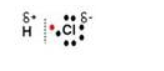
Que-6: What do you understand by dipole (polar) covalent molecule? Explain it by taking hydrogen chloride as an example.
Ans: Covalent compounds are said to be polar when shared pair of electrons are unequally distributed between the two atoms. For example in HCl, the high electronegativity of the chlorine atom attracts the shared electron pair towards itself. As a result, it develops a slight negative charge and hydrogen atom develops a slight positive charge. Hence, a polar covalent bond is formed.
Que-7:
(a) Explain the bonding in methane molecule using the electron dot structure.
(b) The methane molecule is a non-polar molecule. Explain.
Ans: (a)
| Atom | Electronic configuration | Nearest noble gas | To attain stable electronic configuration of a nearest noble gas |
| Carbon | 126C [2,4] | Neon [2,8] | Carbon needs four electrons to complete the octet. |
| Hydrogen | 11H [1] | Helium [2] | Hydrogen needs one electron to complete the duplet. |
One atom of carbon shares four electron pairs, one with each of the four atoms of hydrogen.
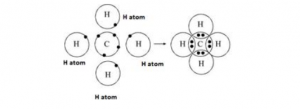
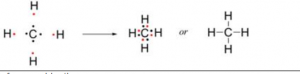
| Before combination
(4 [H] and 1 [C] atom) |
After combination (CH4 – Methane molecule)
|
(b) Methane is a covalent compound and is non-polar in nature. This is because the shared pair of electrons is equally distributed between the two atoms. So, no charge separation takes place and the molecule is symmetrical and electrically neutral.
Que-8: Give the characteristic properties of:
(a) Electrovalent compounds
(b) Covalent compounds
Ans:
(a) Properties of Electrovalent Compounds:
- Ionic compounds usually exist in the form of crystalline solids.
- They have high melting and boiling points.
- These compounds are generally soluble in water but insoluble in organic solvents.
- They are good conductors of electricity in the fused or in an aqueous solution state.
(b) Properties of Covalent Compounds:
- The covalent compounds exist as gases or liquids or soft solids.
- The melting and boiling points of covalent compounds are generally low.
- Covalent compounds are insoluble in water but dissolve in organic solvents.
- They are non-conductors of electricity in the solid, molten or aqueous state.
Que-9: (a) State the type of bond is formed when the combining atoms have:
(i) zero E.N. difference
(ii) small E.N. difference
(iii) large E.N. difference
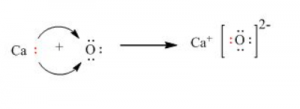
(b) State the type of bond formed, and draw Lewis structure of
(i) water
(ii) calcium oxide
Ans: (a)
(i) Covalent bond
(ii) Polar covalent bond
(iii). Ionic bond
(b) (i) water: Polar covalent bonding takes place in water.

(ii) calcium oxide: Electrovalent bonding takes place in calcium oxide.
Que-10: Explain the following:
(a) Electrovalent compounds conduct electricity.
(b) Electrovalent compounds have a high melting point and boiling point, while covalent compounds have low melting and boiling points.
(c) Electrovalent compounds dissolve in water, whereas covalent compounds do not.
(d) Electrovalent compounds are usually hard crystals yet brittle.
(e) Polar covalent compounds conduct electricity.
(f) Water is a polar covalent molecule ?
Ans: (a) Electrovalent compounds
are good conductors of electricity in the fused or aqueous state because electrostatic forces of attraction between ions in the solid state are very strong and these forces weaken in the fused state or in the solution state. Hence, ions become mobile.
(b) Electrovalent compounds
have a strong force of attraction between the oppositely charged ions, so a large amount of energy is required to break the strong bonding force between ions. So, they have high boiling and melting points.
Covalent compounds have weak forces of attraction between the binding molecules, thus less energy is required to break the force of binding. So, they have low boiling and melting points.
(c) As water is a polar compound, it decreases the electrostatic forces of attraction, resulting in free ions in the aqueous solution. Hence, electrovalent compounds dissolve.
Covalent compounds do not dissolve in water but dissolve in organic solvents. Organic solvents are non-polar; hence, these dissolve in non-polar covalent compounds.
(d) Electrovalent compounds
are usually hard crystals yet brittle because they have strong electrostatic forces of attraction between their ions which cannot be separated easily.
(e) Polar covalent compounds conduct electricity because they form ions in their solutions.
(f) This means that in the water molecule, one side is positively charged and the other side is negatively charged. Since the water molecule (comprising two atoms of Hydrogen and one of Oxygen) is formed by covalent bonds, the electrons are shared.
This sharing causes the electrons to stay closer to the oxygen atom giving it a slight negative charge while the hydrogen atoms, as a consequence, have a slight positive charge.
Que-11: Elements X, Y and Z have atomic numbers 6, 9 and 12, respectively. Which one
(a) forms an anion
(b) forms a cation
(c) State the type of bond between Y and Z and give its molecular formula.
Ans:
(a)
(i) Y = 9
(ii) Z = 12
(b) Ionic bond with molecular formula ZY2.
Que-12: Taking MgCl2 as an electrovalent compound and CCl4 as a covalent compound, give four differences between electrovalent and covalent compounds.
Ans:
| MgCl2 – Electrovalent compound | CCl4 – Covalent compound |
| hard crystalline solids consisting of ions. | gases or liquids or soft solids. |
| high melting and boiling points. | low melting and boiling points. |
| conduct electricity in the fused or aqueous state. | do not conduct electricity in the solid, molten or aqueous state. |
| It is soluble in inorganic solvents but insoluble in organic solvents. | It is insoluble in water but dissolve in organic solvents. |
Que-13: Potassium chloride is an electrovalent compound, while hydrogen chloride is a covalent compound. But both conduct electricity in their aqueous solutions. Explain.
Ans: Potassium chloride is an electrovalent compound and conducts electricity in the molten or aqueous state because the electrostatic forces of attraction weaken in the fused state or in aqueous solution.
Polar covalent compounds like hydrogen chloride ionise in their solutions and can act as an electrolyte. So, both can conduct electricity in their aqueous solutions.
Que-14:
(a) Draw the electron dot structure of covalent compound methane (non polar) and HCL (polar) and give two difference between them .
(b) Name two compounds that are covalent when pure but produce ions when dissolved in water.
(c) For each compound mentioned above, give the formulae of ions formed in the aqueous solution.
Ans: (a) Non-polar covalent compound (Methane, CH4)
1. Covalent compounds are said to be non-polar when shared pair of electrons are equally distributed between the two atoms.
2. No charge separation takes place. The covalent molecule is symmetrical and electrically neutral.
Polar covalent compound (HCl)
1. Covalent compounds are said to be polar when shared pair of electrons are unequally distributed between the two atoms. 2. Charge separation takes place. The atom which attracts electrons more strongly develops a slight negative charge while the other develops a slight positive charge
(b) HCl and NH3
(c) HCl + H2O → H3O+ + Cl–
NH3 + H2O →NH4+ + OH–
Que-15: An element M burns in oxygen to form an ionic bond MO. Write the formula of the compounds formed if this element is made to combine with chlorine and sulphur separately.
Ans: Formula of compound when combined with sulphur – MSFormula of compound when combined with chlorine – MCl2
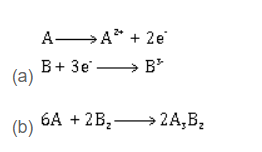
Que-16: Element A has 2 electrons in its M shell. Element B has atomic number 7.
(a) Write equations to show how A and B form ions.
(b) If B is a diatomic gas, write the equation for the direct combination of A and B to form a compound.
(c) If the compound formed between A and B is melted and an electric current is passed through the molten compound, then element A will be obtained at the _________ and B at the ________ of the electrolytic cell.
Ans:
(c) If the compound formed between A and B is melted and an electric current is passed through the molten compound, then element A will be obtained at the cathode and B at the anode of the electrolytic cell.
Que-17: Element M forms a chloride with the formula MCl2 which is a solid with high melting point. M would most likely be in the group in which ………….. is placed.
Que-18: Complete the following
| Sodium | Phosphorus | Carbon | |
| Formula of chloride | |||
| Nature of bonding | |||
| Physical state of chloride |
Ans:
| Sodium | Phosphorus | Carbon | |
| Formula of chloride | NaCl | PCl3, PCl5 | CCl4 |
| Nature of bonding | Ionic Bond | Covalent Bond | Covalent Bond |
| Physical state of chloride | Solid | Liquid, Solid | Liquid |
Que-19: Compound X consists of molecules.
Choose the letter corresponding to the correct answer from the options A, B, C and D given below :
(i) The type of bonding in X will be :
A. ionic
B. electrovalent
C. covalent
D. molecular
(ii) X is likely to have a :
A. low melting point and high boiling point.
B. high melting point and low boiling point.
C. low melting point and low boiling point.
D. high melting point and high boiling point.
(iii) In the liquid state, X will :
A. become ionic,
B. be an electrolyte,
C. conduct electricity,
D. not conduct electricity.
Ans:
(i) C → covalent
Hint: Since, X consists of molecules. Therefore, covalent bond is present.
(ii) C → Low melting point and low boiling point.
Hint: Covalent compounds have low melting and boiling points.
(iii) D → not conduct electricity.
Hint: Covalent compounds are non-conductor of electricity in solid, molten or aqueous state.
—: End of Chemical Bonding Intex-2 Concise Class-10 ICSE Chemistry Selina Solutions Ch-2 : –
Return to:- Concise Selina Chemistry for ICSE Class-10 Solutions
Please Share with Your Friends if Helpful
Thanks