Hydrogen Chloride Long Ans Concise Class-10 ICSE Chemistry Selina Solutions Chapter-8. We Provide Step by Step Answer of Long Ans Questions of Exercise-8 for ICSE Class-10. The given Solutions is according to the Latest editions. Visit official Website CISCE for detail information about ICSE Board Class-10.


Hydrogen Chloride Long Ans Concise Class-10 ICSE Chemistry Selina Solutions Chapter-8
| Board | ICSE |
| Book / Publication | Concise / Selina |
| Subject | Chemistry |
| Class | 10th |
| Writer | Dr SP Singh |
| Chapter-8 | Study of Compounds – Hydrogen Chloride |
| Topics | Long Ans |
| Edition | 2025-2026 |
Long Ans Questions on Study of Compounds-Hydrogen Chloride
Page-152
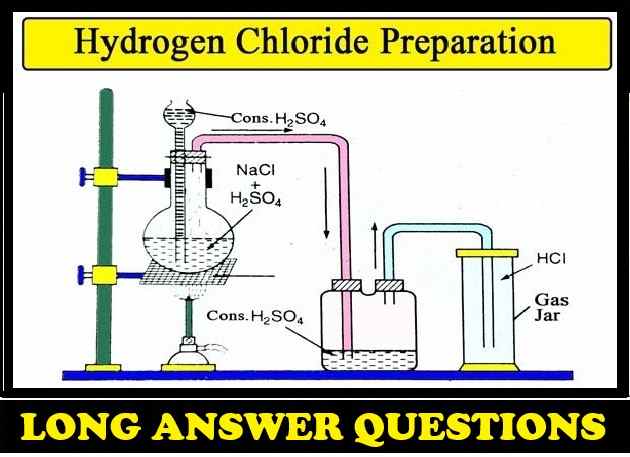
Que-1: Draw a labelled diagram for the laboratory preparation of hydrogen chloride gas and answer the following
(a) Name the acid used. Why is this particular acid preferred to other acids? (2018)
(b) Give the balanced equation for the reaction.
(c) Name the drying agent used in drying hydrogen chloride gas.
(d) Phosphorous penta oxide and calcium oxide are good drying agents, but they cannot be used to dry hydrogen chloride gas. Why?
(e) Why is direct absorption of HCl gas in water not feasible?
(f) What arrangement is done to dissolve HCl gas in water?
Ans:
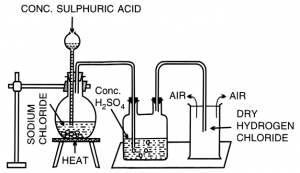
(a) Concentrated H2SO4
(b) The balanced equation for the reaction:

(c) The drying agent used in drying hydrogen chloride gas is conc. sulphuric acid.
(d) Phosphorous pentoxide and calcium oxide are good drying agents, but they cannot be used to dry hydrogen chloride gas because they react with hydrogen chloride.
2P2O5 + 3HCl ⟶ POCl3 + 3HPO3
CaO + 2HCl ⟶ CaCl2 + H2O
(e) Hydrogen chloride gas is highly soluble in water. Therefore, it is not collected over water.
(f) The funnel arrangement is done to dissolve HCl gas in water.
Que-2: The given set up of the figure is for preparation of an acid.
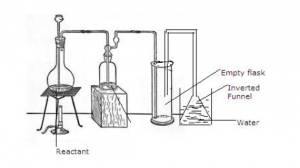
(a) Name the acid prepared by this method.
(b) Name the reactants used.
(c) Why empty flask is used.
(d) What is drying agent used? Why is this drying agent chosen?
(e) What is the role of inverted funnel in the arrangement?
Ans:
(a) Hydro chloric acid is prepared by this method.
(b) The reactants are sodium chloride and Sulphuric acid.
(c) The empty flask acts as Anti-Suction device. In case the back suction occurs the water will collect in it and will not reach the generating flask.
(d) The drying agent is Conc. Sulphuric acid. Sulphuric acid is chosen as drying agent because it does not react with HCl.
(e) The Inverted funnel :
Prevents or minimizes back suction of water.
Provides a large surface area for absorption of HCl gas.
Que-3: How will you prove that Hydrochloric acid contains (i) Hydrogen (ii) Chlorine.
Write equations for the reactions.
Ans: We can prove that hydrochloric acid contains both hydrogen and chlorine by the following experiment.
Take a voltameter used for electrolysis of water, fitted with platinum cathode and graphite anode.
Into the voltameter pour 4 molar HCl and pass direct current.
It is seen that a colourless gas is evolved at cathode and a greenish gas is evolved at anode.
When a burning splinter is brought near a colourless gas, it bursts into flame thereby proving that it is hydrogen gas.
When moist starch iodide paper is held in the greenish yellow gas, it turns blue black, thereby proving that the gas is chlorine.
2HCl ? H2 + Cl2
This experiment proves that hydrochloric acid contains both hydrogen and chlorine
Que-4: Give three distinct tests (apart from using an indicator) you would carry out with solution of HCl to illustrate the typical properties of an acid.
Ans: Three tests are:
HCl gas gives thick white fumes of ammonium chloride when glass rod dipped in ammonia solution is held near the vapours of the acid.
NH3 + HCl  NH4Cl
NH4Cl
With silver nitrate HCl gives white precipitate of silver chloride. The precipitate is insoluble in nitric acid but soluble in ammonium hydroxide.
AgNO3 + HCl AgCl + HNO3
A greenish yellow gas is liberated when concentrated hydrochloric acid is heated with oxidizing agent like manganese dioxide.
MnO2 + 4HCl MnCl2 +2H2O + Cl2
Que-5: Convert:
(a) Two soluble metallic nitrates to insoluble metallic chlorides.
(b) Insoluble iron(II) oxide to a soluble compound.
(c) Insoluble metal carbonate to a soluble chloride.
(d) Metal sulphide to an offensive smelling gas.
Ans:
(a) Pb(NO3)2 + 2HCl ⟶ PbCl2 + 2HNO3
Hg2(NO3)2 + 2HCl ⟶ Hg2Cl2 + 2HNO3
(b) FeO + 2HCl ⟶ FeCl2 + H2O
(c) CaCO3 + 2HCl ⟶ CaCl2 + H2O + CO2 ↑
(d) Na2S + 2HCl ⟶ 2NaCl + H2S ↑
Que-6: Study the flow chart and give balanced equations with conditions for the conversions A, B, C,D and E.
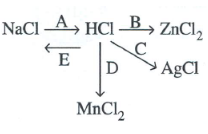
Ans:
NaCl + H2SO4 → NaHSO4 + HCl
Fe + 2HCl → FeCl2 + H2
HCl + NH3 → NH4Cl
PbO2 + 4HCl → PbCl2 + 2H2O + Cl2
Que-7: In the laboratory preparation of hydrochloric acid, hydrogen chloride gas is dissolved in water.
(i) Draw a diagram to show the arrangement used for the absorption of HCl gas in water.
(ii) State why such an arrangement is necessary. Give two reasons for the same.
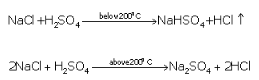
(iii)Write balanced chemical equations for the laboratory preparation of HCl gas when the reaction is
A. Below 200°C;
B. Above 200°C.
Ans: (i) Diagram to show the arrangement used for the absorption of HCl gas in water:
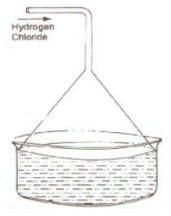
(ii) Such an arrangement is necessary to prevent back suction of water into the apparatus and it provides a large surface area for dissolution of hydrogen chloride gas.
(iii) Balanced chemical equations for the laboratory preparation of HCl gas:
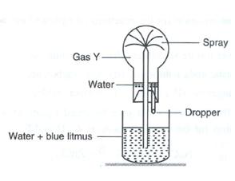
Que-8: Study the given figure and answer the questions that follow:
(i) Identify the gas Y.
(ii) What property of gas Y does this experiment demonstrate?
(iii). Name another gas which has the same property and can be demonstrated through this experiment.
Ans:
(i) The gas is HCl (hydrogen chloride) gas.
(ii) The extreme solubility of hydrogen chloride gas is demonstrated by the fountain experiment.
(iii). Another gas which has the same property and can be demonstrated through this experiment is ammonia gas.
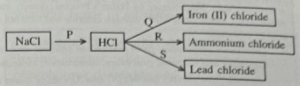
Que-9: Refer to the diagram given below and write balanced equations with conditions, if any, for the following conversions P to S.
Ans:
P — NaCl+H2SO4 → (<200°C) NaHSO4 + HCl [g]NaCl
Q — Fe + 2HCl (dil.) ⟶ FeCl2 + H2 [g]
R — NH4OH + HCl (dil.) ⟶ NH4Cl + H2O
S — PbO2+4HCl → ΔPbCl2+ 2H2O + Cl2Pb
Que-10: State your observations:
(a) HCl gas is passed through lead nitrate solution and the mixture is heated.
(b) Hydrochloric acid is added to silver nitrate solution.
(c) Ammonium hydroxide solution is added to the resultant product of part (b).
Ans:
(a) When HCl gas is passed through lead nitrate, white precipitate of lead chloride is formed.
Pb(NO3)2 + 2HCl ⟶ PbCl2 ↓ + 2HNO3
(b) Hydrochloric acid, when reacted with silver nitrate solution it gives a thick curdy white precipitate of silver chloride. This white precipitate is insoluble in nitric acid.
AgNO3 + HCl ⟶ AgCl ↓ + HNO3
(c) On addition of ammonium hydroxide, the resultant of part (b) i.e., thick curdy white precipitate of silver chloride dissolves and forms a complex salt called diammine silver (I) chloride.
AgCl + 2NH4OH ⟶ [Ag(NH3)2Cl)] + 2H2O
Que-11: Distinguish by using HCl.
(a) Lead nitrate solution and silver nitrate solution.
(b) Potassium sulphite and potassium sulphide.
Ans:
(a) On reaction with HCl, lead nitrate solution gives white precipitate which can be dissolved in hot water.
Pb(NO3)2 + 2HCl ⟶ PbCl2 ↓ + 2HNO3
Therefore, silver nitrate solution gives thick curdy white precipitate which is insoluble in hot water.
AgNO3 + HCl ⟶ AgCl ↓ + HNO3
(b) On reaction with HCl, potassium sulphite gives SO2 gas with pungent odour
K2SO3 + 2HCl ⟶ 2KCl + H2O + SO2 ↑
Therefore, potassium sulphide gives H2S gas with rotten eggs odour.
K2S + 2HCl ⟶ 2KCl + H2S ↑
Que-12: The following questions pertain to the laboratory preparation of hydrogen chloride gas:
(a) Write the equation for it’s preparation mentioning the conditions required.
(b) Name the drying agent used in the above preparation and give a reason for the choice.
(c) State a safety precaution taken during the preparation of hydrochloric acid.
Ans:
(a) The equation for the laboratory preparation of hydrogen chloride gas :
NaCl + H2SO4 → (<200°C) NaHSO4 + HCl [g]NaCl
(b) Concentrated sulphuric acid is used as the drying agent used in the above preparation.
Que-13: Identify the gas evolved and give the chemical test in each of the following cases.
Dilute hydrochloric acid reacts with:
(i) Iron [II] sulphide.
(ii) Sodium sulphite.
Ans:
(i) H2S gas is evolved when dilute hydrochloric acid reacts with Iron [II] sulphide.
FeS + 2HCl ⟶ FeCl2 + H2S ↑
(ii) SO2 is evolved when dilute hydrochloric acid reacts with sodium sulphite.
Na2SO3 + 2HCl ⟶ 2NaCl + H2O + SO2 [g] ↑
—: End of Study of Compounds – Hydrogen Chloride Long Ans Concise Class-10 ICSE Chemistry Selina Solutions : –
Return to:- Concise Selina Chemistry for ICSE Class-10 Solutions
Please Share with Your Friends if Helpful
Thanks