ICSE Class 10 Notes on Arithmetic Progression OP Malhotra Maths 2026-27. We Provide Step by Step Answer of all the exercises with Chapter Test of S Chand OP Malhotra Maths . Visit official Website CISCE for detail information about ICSE Board Class-10.
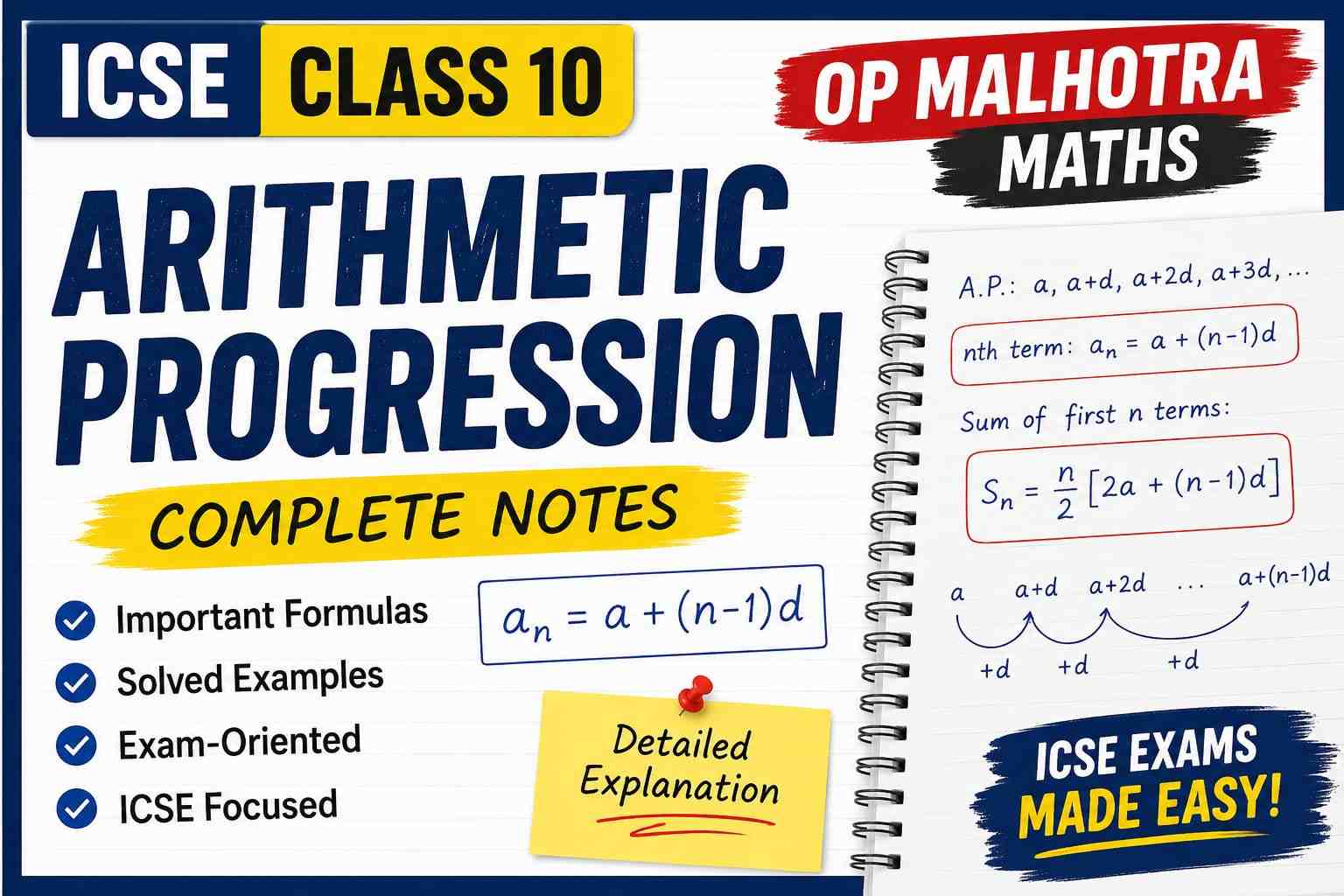


ICSE Class 10 Notes on Arithmetic Progression OP Malhotra Maths 2026-27
Sequence
A sequence is a set of numbers arranged in a definite order according to some rule. Each number is called a term.
Finite sequence → has a last term. e.g. 4, 9, 14, 19, 24
Infinite sequence → has no last term. e.g. 40, 35, 30, …, −5, …
Series
A series is the sum of the terms of a sequence.
Sequence: 2, 7, 12, 17, … → Series: 2 + 7 + 12 + 17 + …
Arithmetic Progression (AP)
A sequence in which terms increase or decrease by the same fixed number is an AP. That fixed number is the common difference (d); the first term is a.
General form of an APa, a+d, a+2d, a+3d, …
| AP | a | d |
|---|---|---|
| 5, 8, 11, 14, 17 | 5 | 3 |
| 9, 5, 1, −3, −7 | 9 | −4 |
👉 d > 0 → AP is increasing | d < 0 → AP is decreasing.
nth Term Formula
nth term of an AP ⇒ Tn = a + (n − 1)d
Common difference ⇒ d = Tn − Tn−1
Solved Examples
Ex. 1 Find the 16th term of the AP 3, 10, 17, 24, …
Tn = a + (n−1)d
T16 = 3 + (16−1)×7 = 3 + 105
T16 = 108
Ex. 2 The 7th term of an AP is −4 and its 13th term is −16. Find the AP.
T7 = a + 6d = −4 …(i)
T13 = a + 12d = −16 …(ii)
Subtracting (i) from (ii):
6d = −12 ⟹ d = −2
From (i): a + 6(−2) = −4 ⟹ a = 8
The required AP is 8, 6, 4, 2, …
Ex. 3 Check whether −83 is a term of the AP 5, 2, −1, −4, …
Tn = a + (n−1)d = −83
5 + (n−1)(−3) = −83
−3(n−1) = −88 ⟹ n−1 = 88/3 ⟹ n = 92/3
n is not a whole number → −83 is NOT a term of the given AP.
Ex. 4 Find the 12th term from the last term of the AP 21, 18, 15, …, −81.
−81 = 21 + (n−1)(−3)
−3(n−1) = −102 ⟹ n − 1 = 34 ⟹ n = 35
12th from the end = (35 − 12 + 1)th from start = 24th term
T24 = 21 + (24−1)(−3) = 21 − 69
T24 = −48
Ex. 5 Find the middle term of the AP 6, 13, 20, …, 216.
216 = 6 + (n−1)×7 ⟹ 7(n−1) = 210 ⟹ n = 31
n = 31 (odd) → middle term = 16th term
T16 = 6 + (16−1)×7 = 6 + 105
Middle term = 111
Practice Questions on this topic : Exercise- 9(a)
Sum of n terms
Sum of n terms of AP (S) = n/2[2a + (n – 1)d]
or
S = n/2(a+l)
where n is number of terms ,
a is the first term of AP
l is the last term of AP
Note:
- Each of the formulas contains four quantities . Thus three being known , fourth can be found out.
- Also, Tn = Sn+ Sn-1
Practice Questions on this topic : Exercise-9(b)
GEOMETRIC PROGRESSION (G.P.)
A Geometric Progression (G.P.) is a sequence in which each term is obtained
by multiplying the previous term by the same number.
This fixed number is called the Common Ratio (r).
Examples
- 2, 4, 8, 16, …
- 27, 9, 3, 1, …
- 1, -2, 4, -8, …
Common Ratio (r)
r = Next Term/Previous Term
Example
2, 6, 18, 54
r = 6 ÷ 2 = 3
Standard Form of G.P.
a, ar, ar², ar³, ar⁴, …
- a = First term
- r = Common ratio
nth Term of G.P.
- a = First term
- r = Common ratio
- n = Term number
Solved Examples
Example 1 : Check whether 27, 9, 3, 1 is a G.P.
Solution :9 ÷ 27 = 1/3
3 ÷ 9 = 1/3
1 ÷ 3 = 1/3
Answer: Yes, it is a G.P.
Example 2 : Find the common ratio of 2, 6, 18, 54.
Solution :
r = 6 ÷ 2 = 3
Answer: r = 3
Example 3 : Find the 5th term of 3, 6, 12, 24, …
Solution :a = 3, r = 2
T₅ = 3 × 2⁴ = 48
Answer: 48
Example 4 : Which term of the G.P. 6, 2, 2/3, … is 2/243?
Solution:
a = 6, r = 1/3
6 × (1/3)n−1 = 2/243
(1/3)6 = (1/3)n−1
n = 7
Answer: 7th term
Practice Questions on this topic : Exercise-9(c)
SUM OF n TERMS OF A GEOMETRIC PROGRESSION
The sum of the first n terms of a Geometric Progression is denoted by Sn.
If the first term is a, common ratio is r and number of terms is n, then
Sn = a + ar + ar2 + ar3 + … + arn−1
Formulae
Case 1 : When r < 1
Sn = a(1 − rn)/(1 − r)
Case 2 : When r > 1
Sn = a(rn − 1)/(r − 1)
Note: Both formulae give the same answer. Use the one which is easier.
Solved Examples
Example 1 : Find the sum of the first 5 terms of 2, 4, 8, 16, …
Solution:
Given:
a = 2,
r = 2,
n = 5
S5 = 2(25 − 1)/(2 − 1)
= 62
Answer: 62
Example 2 : Find the sum of the first 4 terms of 81, 27, 9, 3, …
Solution :
Given:
a = 81,
r = 1/3,
n = 4
S4 = 81(1 − (1/3)4)/(1 − 1/3)
= 120
Answer: 120
Example 3 : How many terms of the G.P. 5, 20, 80, … have sum 6825?
Solution :
Given:
a = 5,
r = 4,
Sn = 6825
6825 = 5(4n − 1)/3
4n = 4096
46 = 4096
Answer: n = 6
Example 4 : The third term of a G.P. is 5/2 and the eighth term is 5/64.
Find the sum of the first 10 terms.
Solution :
T3 = ar2 = 5/2
T8 = ar7 = 5/64
r = 1/2
a = 10
S10 = 10(1 − (1/2)10)/(1 − 1/2)
= 5115/256
Answer: 5115/256
Practice Questions on this topic : Exercise-9(d)
Self Evaluation and Revision : Coming Soon
— : End of ICSE Class 10 Notes on Arithmetic Progression OP Malhotra Maths 2026-27 :–
Return to :– OP Malhotra S Chand Solutions for ICSE Class-10 Maths
Thanks
Please Share with Your Friends