MCQs on Continuity and Differentiability Class 12 OP Malhotra ISC Maths Solutions Ch-7. In this article you would learn full concept recap of continuity and Differentiability. Visit official Website CISCE for detail information about ISC Board Class-12 Mathematics.


Continuity and Differentiability Class 12 OP Malhotra MCQ and short answer ISC Maths Solutions Ch-7
| Board | ISC |
| Publications | S Chand |
| Subject | Maths |
| Class | 12th |
| Chapter-7 | Continuity and Differentiability |
| Writer | OP Malhotra |
| Exe | MCQ and Short Answer |
MCQ and Short Answer on Continuity and Differentiability
OP Malhotra ISC Class 12 Maths Solutions
Fill in the blanks
1. A real valued function f is continuous at a point x = a if it is defined at x = a and if lim(x→a-1)f(x) = lim(x→a+1) = _____
Ans – A real valued function f is continuous at a point x = a if it is defined at x = a and if lim(x→a-1)f(x) = lim(x→a+1) = f(a)
2. A real function f(x) is said to be differentiable at x = a if _______.
Ans- A real function f(x) is said to be differentiable at x = a if left hand , right hand derivative and f(a) exists and are equal.
3. If u and v are two function of x, then derivative of u/v ie.. (u/v)’ =_____ .
Ans- If u and v are two function of x, then derivative of u/v ie.. (u/v)’ = vu’-uv’/v²
4. If the graph of a function/can be drawn around a point the pen from the paper, then the function is _____ .
Ans- If the graph of a function/can be drawn around a point the pen from the paper, then the function is continuous .
5. If the graph of a function around a point cannot be drawn without lifting the pen from the paper, then function is ____ .
Ans- If the graph of a function around a point cannot be drawn without lifting the pen from the paper, then function is discontinuous at that point .
6. Examine the continuity of the function. f(x)= { x² when x≠1 and 2 when x= 1. The function is_______ at x = 1 .
Ans- The function is discontinuous at x = 1 .
7. The graph of a function has a _____ as shown in fig.7 and so it is a ______ function.
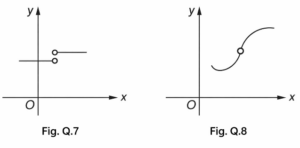
Ans- The graph of a function has a discontinuity as shown in fig.7 and so it is a discontinuous function.
8. The graph of a function has a ______ as shown in fig.8 and so it is a ______ function.
Ans- The graph of a function has a dicontinuity as shown in fig.8 and so it is a discontinuous function.
9. The function f(x) = x³ – 7x² + 5 being a _____ function is _____ .
Ans- The function f(x) = x³ – 7x² + 5 being a polynomial function is continuous and differentiable everywhere .
Tick the correct answer
10. The composition gof of two continuous functions is continuous/discontinuous.
Ans- The composition gof of two continuous functions is continuous .
Multiple Choice Questions
1. If f(x) = {3x-8, if x≤5 and 2k,if x≥ 5 is continuos , find k
(a) 3/7 (b)7/2 (c)2/7 (d)4/7
Sol: (b)7/2
We have f(x) = {3x-8, if x≤5 and 2k,if x≥ 5
f(x) is continuous at x=5
LHL=RHL=f(5)
LHL = lim(x→5)(3x-8) = 7
RHL = lim(x→5)(2k) = 2k
as LHL = RHL
then 2k=7
k=7/2
2. If f(x) = 2x and g(x) = x²/2+1 , then which of the following can be a discontinuous function ?
(a) f(x)+g(x) (b) f(x)-g(x) (c) f(x).g(x) (d)f(x)/g(x)
Sol: (d)f(x)/g(x)
We know that algebraic expressions are everywhere
if f(x) and g(x) are continuous functions
then ,
f(x)+g(x) is continuous
f(x)-g(x) is continuous
f(x).g(x) is continuous
f(x)/g(x) is continuous only when g(x)≠0
3. If f(x) = {3x-8 , if x≤5 and 2k , if x >5 is continuous , find k.
(a) 3/7 (b)7/2 (c)2/7 (d)4/7
Sol: (b)7/2
We have f(x) = {3x-8, if x≤5 and 2k,if x≥ 5
f(x) is continuous at x=5
LHL=RHL=f(5)
LHL = lim(x→5)(3x-8) = 7
RHL = lim(x→5)(2k) = 2k
as LHL = RHL
then 2k=7
k=7/2
4. The function f(x) = 4-x²/4x-x³ is
(a)discontinuous at only one point
(b)discontinuous at exactly two points
(c)discontinuous at exactly three points
(d)none of the above
Sol: (c) discontinuous at exactly three points
f(x) = 4-x²/4x-x³
f(x)= 4-x²/x(4-x²)
f(x) = 1/x , x≠0 and 4-x²≠0 i.e x≠±2
5. Let f and g be two real functions at a real number c . Then , which of the following statements is/are true ?
I. f+g is a continuous at x=c.
II. f-g is continuous at x=c .
III. f.g is continuous at x=c .
IV. f/g is continuous at x=0 provided g(x)≠0
(a) I and II (b)II and III (c) I , II and III (d) All
Sol: (c) I , II and III
6. A real function f is said to be continuous , if it continuous at every point in the
(a) domain of f (b) co-domain of f (c) range of f (d) none of these
Sol: (a) domain of f
7. If f(x) = {kx² , if x≤2 and 3 , if x>2 is continuous at x=2 , then the value of k is
(a) 4/3 (b)-4/3 (c)3 (d)4
Sol: 3/4
LHL=RHL
lim(x→2)(kx²)=lim(x→2)(3)
4k=3
k=3/4
8. Which of the following functions is/are continuous ?
I.constant function
II. polynomial function
III. modulus function
IV.sine function
(a) only I (b) only II (c) II , III and IV (d) All of these
Sol:(d) All of these
9.The function f(x) = 2x²+cosx+ex-2 is
(a) discontinuous at x=0 (b) discontinuous at x=π
(c) discontinuous at x=π/2 (d) continuous at all points
Sol: (d) continuous at all points
as 2x² is continuous everywhere
cosx is continuous for all real numbers
ex is continuous for all real numbers
-2 is a constant function which is continuous everywhere
therefore ,
2x²+cosx+ex-2 is continuous at all points
10. If the function f(x) = {(x²-1)/(x-1) , when x≠1 and k, when x=1 is given to be continuous at x≠1 , then the value of k is ,
(a)-2 (b)3 (c)1/2 (d)2
Sol: (a)2
f(x) = (x²-1)/(x-1)
= (x-1)(x+1)/(x-1) = (x+1)
f(x) = x+1
for a function to be continuous to be continuous at x=1
lim(x→1)f(x) = lim(x→1)(x+1)
lim(x→1)f(x) = 1+1
lim(x→1)f(x) = 2
solving for continuity ,
lim(x→1)f(x) = f(1)
2 = k
k=2
11. The number of points of discontinuity of f defined by |x|-|x+1| is
(a)1 (b)2 (c)0 (d)None of these
Sol: (c)0
f(x) = |x|-|x+1|
there are two functions g and h
g=|x| and h=|x+1|
then f=g-h
the continuity of g and h is examined first ,
g(x) = |x| can be written as
g(x) = {x , x≥0 and -x , x<0
clearly g is defined for all real numbers
h(x) = |x+1| can be written as
h(x) = {-(x+1) , x<0 and (x+1) , x≥0
clearly h is defined for all real numbers
12. If a function f is defferentiable at c , then it is
(a) discontionuous at c (b) continuous at c
(c) not defined at c (d) none of these
Sol: (b) continuous at c
13. Which of the following is not correct statement ?
A function is not differentiable at x=a , if
(a) either or both Rf'(a) and Lf'(a) do not exist
(b) both Rf'(a) and Lf'(a) exist but are not equal
(c) Rf'(a) and Lf'(a) both exist and are equal
(d) either or both Rf'(a) and Lf'(a) are not finite
Sol: (c) Rf'(a) and Lf'(a) both exist and are equal
14. Let f(x) = {cx²+2x , if x<2 and 2x+4 , if x≥2 . If the function is continuous on (-∞,∞) , then the value of a is equal to
(a) 4 (b) 2 (c)3 (d)1
Sol: (d)1
f(x) = {cx²+2x , if x<2 and 2x+4 , if x≥2
if the function is continuous at R
LHL = RHL = f(x)
LHL= lim(x→2)(cx²+2x) = 4c+4
f(x) = f(2) = 2(2)+4 = 4+4 =8
LHL = f(2)
4c+4 = 8
4c = 4
c=1
15. The function f(x) = {x-1 , x<2 and 2x-3, x≥2 is a continuous function for
(a) x=2 only (b) all integral values of x only (c) all real values of x (d) all real values of x such that x≠2
Sol: (c) all real values of x
For the interval (x<2), the function is defined as f(x)=x-1.
Since this is a linear polynomial, it is continuous for all x in (-∞ ,2).
Similarly, for (x>2), the function is defined as f(x)=2x-3, which is also a linear polynomial and continuous for all x in (2,∞).
check continuity at x=2,
LHL = lim(x→2–)(x-1)= 2-1 = 1
RHL = lim(x→2+)(2x-3) = 2(2)-3 = 4-3 = 1
f(2) = 2(2)-3 = 4-3 = 1
therfore , the function is continuous on R
16. Let f(x) be a function differentiable at x=c , then lim(x→c)f(x) equals
(a) f(x) (b)f”(x) (c) 1/f(c) (d) None of these
Sol: (d) None of these
17. If f(x) = {(1-coskx)/xsinx , if x≠0 and 1/2 , if x=0 is continuous at x=0 , then the value of k is
(a) 0 (b) ±2 (c) ±1 (d) ±1/2
Sol: (c) ±1
f(x) = {(1-cosx)/xsinx , if x≠0 and 1/2 , if x=0
if the function is continuous at x=0
LHL = RHL = f(x)
LHL = f(x)
lim(x→0–)((1-cosx)/(xsinx)) = f(0)
lim(x→0–)(2sin²(kx/2))×1/xsinx) = 1/2
lim(x→0–)(2sin²(kx/2)×(kx/2)²/(kx/2)²)×1/(x×xsinx/x)) = 1/2
lim(x→0–)(2(sin(kx/2)/(kx/2))²×k²x²/4x²×1/(sinx/x)) = 1/2
2×k²/4×.1/1 = 1/2
k¹ = 1
k =±1
18. If f(x) = |sinx| , then
(a) f is everywhere differentiable
(b) f is everywhere continuous but not differentiable at x=nπ, n∈Z
(c) f is everywhere continuous but not differentiable at x=(2n+1)π/2 , n∈Z
(d) None of these
Sol: (b) f is everywhere continuous but not differentiable at x=nπ, n∈Z
19. If f(x) = {mx+1, if x≤π/2 and sinx+n, if x>π/2 is continuous at x=π/2 , then
(a) m=1,n=0 (b) m=nπ/2+1 (c) n=mπ/2 (d)
Sol: (c)n=mπ/2
as the function is continuous at x = π/2
f(x) = {mx+1, if x≤π/2 and sinx+n, if x>π/2
LHL = RHL = f(x)
lim(x→π/2)(mx+1) = lim(x→π/2)(sinx+n)
mπ/2 + 1 = sin(π/2) + n
mπ/2 + 1 = 1 + n
mπ/2 = n
therefore n = mπ/2
Very Short Answer type questions
1. Determine the value of the constant ‘k’ so that the function f(x) = {kx/|x| , if x<0 and 3, if x≥0 is continuous at x=0 .
Sol: Given f(x) = {kx/|x| , if x<0 and 3, if x≥0
since the function is continuous at x=0 , therefore ,
lim(x→0–)f(x) = lim(x→0+)f(x) = f(0)
lim(x→0)(-kx/x) = lim(x→0)(3) = 3
-k = 3
k = -3
2. If the function f defined as f(x) = {(x²-9)/(x-3) , x≠3 and k, x=3 is continuous at x=3 , find the value of k.
Sol: since f(x) is continuous at x=3
therefore , f(1) = lim(x→3)f(x)
k = lim(x→3)((x²-9)/(x-3))
k = lim(x→3)(x+3)
k = 6
3. If f(x) = {x²,when x≠1 and 0,when x=1 , find whether it is continuous or discontinuous at x=1.
Sol: f(x) = {x²,when x≠1 and 0,when x=1
for a function to be continuous at x=1 , it’s LHL = RHL = f(1)
LHL = lim(x→1–)(x²) = 1
RHL = lim(x→1+)(x²) = 1
f(1) = 0
since , LHL = RHL ≠ f(1)
therefore , the function is not continuous at x=1
4. If the function f(x) = {sin(3x/2)/x , x≠0 and k , x=0 is continuous at x=0 , then write the value of k.
Sol: f(x) = {sin(3x/2)/x , x≠0 and k , x=0
if the function is continuous at x=0
LHL = RHL = f(0)
LHL = f(0)
lim(x→0–)(sin(3x/2)/x) = k
lim(x→0–)(sin(3x/2)/(3x/2) × 3/2) = k
1×3/2 = k
k = 3/2
5. Examine the continuity of the function f(x) = x³+x²-1
Sol: f(x) = x³+x²-1
to check if f(x) polynomial
we check if it is continuous at any point x=c
let c be any real number ,
f is continuous at x=c
if lim(f(x)) = f(c)
LHS = lim(x→c)(x³+x²-1) = c³+c²-1
RHS = f(c) = c³+c²-1
since LHS=RHS
∴Function is continuos at x=c
so , we can say that f(x) is continuous for x=c , where c∈R
∴ f is continuous for every real number.
6. Examine the continuity of f(x) = {3x+5 , if x≥2 and x² , if x<2
Sol: f(x) = {3x+5 , if x≥2 and x² , if x<2
to check continuity of f(x) at x=2
LHL = RHL = f(2)
LHL = lim(x→2–)(x²) = (-2)² = 4
RHL = lim(x→2+)(3x+5) = 3(-2)+5 = -6+5 = -1
f(2) = 3(-2)+5 = -6+5 = -1
since ,
f(2) = RHL ≠ LHL
therefore , the function is discontinuous at x=2
7. Examine the continuity of f(x) = {|x-4|/2(x-4) , if x≠4 and 0 , if x=4
Sol:f(x) = {|x-4|/2(x-4) , if x≠4 and 0 , if x=4
at x=4 ,
LHL = lim(x→4–)(|x-4|/2(x-4)
= lim(h→0)(|(4-h)-4|/2((4-h)-4)
= lim(h→0)(|-h|/-2h)
= lim(h→0)(h/-2h)
= lim(h→0)(-1/2)
= -1/2
f(4) = 0
since , LHL ≠ f(4)
So, f(x) is discontinuous at x=4
8. Examine the continuity of f(x) = |x|+|x-1| at x=1.
Sol: f(x) = |x|+|x-1| at x=1
at x=1 ,
LHL = lim(x→1–)f(x) = lim(x→1–)(|x|+|x-1|)
= lim(h→0)(|1-h|+|1-h-1|)
= lim(h→0)(|1-h|+|-h|)
= lim(h→0)(|1-h|+h) = |1-0|+0 = 1
RHL = lim(x→1+)f(x) = lim(x→1+)(|x|+|x-1|)
= lim(h→0)(|1+h|+|1+h-1|)
= lim(h→0)(|1+h|+|h|)
= lim(h→0)(|1+h|+h) = |1+0|+0 = 1
f(1) = |x|+|x-1| = |1|+|1-1| = 1-0 = 1
since , LHL = RHL = f(1)
therefore , f is continuous at x=1
9. If f(x) = 2|x| + 3|sinx| + 6 , then the right hand derivative of f(x) at x = 0 is ________ .
Sol: f(x) = 2|x| + 3|sinx| + 6
f(0) = 2|0|+3|sin0|+6 = 0+3(0)+6 = 6
RHD = f'(0+) = lim(h→0+)(f(0+h)-f(0)/h) = lim(h→0+)((2|0+h|+3|sin(0+h)|+6)-6/h) = lim(h→0+)((2|h|+3|sin(h)|+6)-6/h) = lim(h→0+)(2|h|+3|sin(h)|/h)
= lim(h→0+)(2 + 3|sin(h)|/h) = 2 + 3.1 = 2+3 = 5
therefore , the right hand derivative is 5
10. Let f(x) = x|x| , for all x∈R , check its differentiability at x=0 .
Sol: we may write f(x) = {x², if x≥0 and -x² , if x<0
LHD = f'(0–) = lim(h→0–)((f(0-h)-f(0))/h)
= lim(h→0–)(-h²-0)/h = lim(h→0–)(-h) = 0
LHD = f'(0+) = lim(h→0–)((f(0+h)-f(0))/h)
= lim(h→0–)(h²-0)/h = lim(h→0–)(h) = 0
since the left hand derivative and right hand derivative are equal , hence f is differentiable at x = 0
–: End of MCQs on Continuity and Differentiability Class 12 OP Malhotra ISC Maths Solutions :–
Return to :- OP Malhotra ISC Class-12 S Chand Publication Maths Solutions
Please share with your friends
Thanks