
OP Malhotra Factorisation Class-9 S.Chand ICSE Maths Ch-4 Solution 2026. We Provide Step by Step Answer of Exe-4(a), Exe-4(b), Exe-4(c), Exe-4(d), Exe-4(e), Exe-4(f), Exe-4(g), Exe-4(h), with Chapter Test of S Chand OP Malhotra Maths . Visit official Website CISCE for detail information about ICSE Board Class-9.
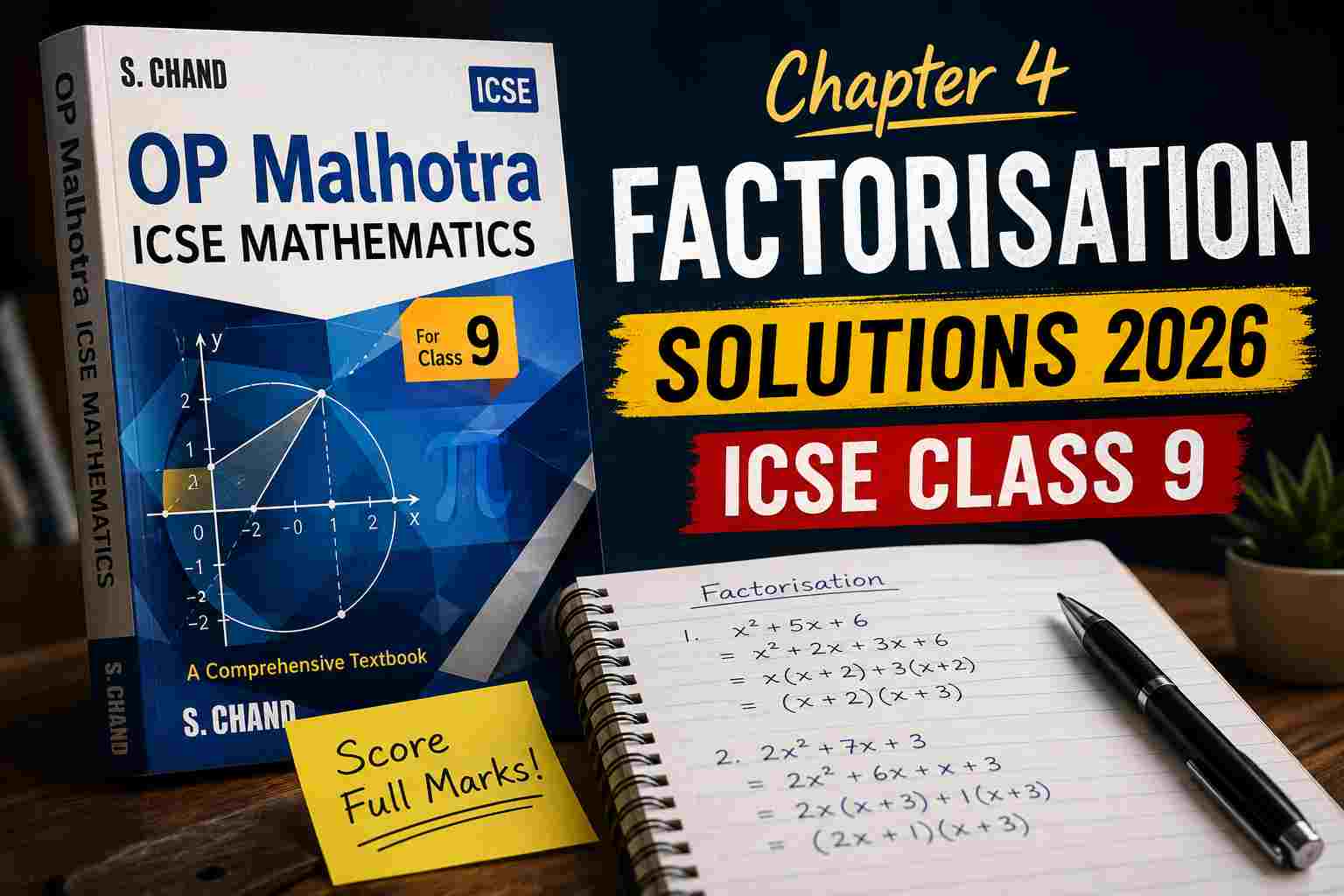


OP Malhotra Factorisation Class-9 S.Chand ICSE Maths Ch-4
Factorisation :
Factorisation or factoring is the decomposition of an object (for example, a number, a polynomial, or a matrix) into a product of other objects, or factors, which when multiplied together give the original.
For example, the number 15 factors into primes as 3 × 5, and the polynomial x^2 − 4 factors as (x − 2) (x + 2).
In all cases, a product of simpler objects is obtained. It is actually the opposite of expansion.
Methods of factorization:
1. Taking out the common factors.
2. Grouping
3. Splitting of the middle terms.
4. Difference of two squares.
5. The sum or difference of two cubes.
Factorisation by Taking Common
To factorize an expression by taking out the common factor, identify the greatest common factor (GCF) of all terms and then write the expression as a product of the GCF and the remaining factors
Step for Factorisation by Taking Common
- Identify the Common Factor: Look for the largest number and/or variable that divides each term in the expression without leaving a remainder.
- Factor out the Common Factor: Divide each term in the expression by the common factor and place the common factor outside a set of parentheses.
- Write the Remaining Factors: The terms inside the parentheses will be the result of dividing each original term by the common factor.
Practice Questions on Taking Common :- Exercise-4(a)
Factorisation by Regrouping
Factorization by regrouping involves rearranging an algebraic expression, which are then extracted to simplify the expression. This method is particularly useful when expressions don’t have a straightforward common factor across all terms, but can be grouped to reveal common factors within subgroups
Step for Factorisation by Regrouping
- Identify and rearrange terms: Group terms that share a common factor.
- Factor out common factors: Within each group, identify and factor out the common factor.
- Look for a common binomial factor: If, after factoring out the common factors, the remaining expressions within parentheses are identical, this is your common binomial factor.
- Final factorization: Express the factored expression as the product of the common binomial factor and the remaining expression
For example : 𝑎² − 2𝑏 − 2𝑎 + 𝑎𝑏
= 𝑎² − 2𝑎 + 𝑎𝑏 − 2𝑏
= 𝑎(𝑎 − 2) + 𝑏(𝑎 − 2)
=(𝑎 + 𝑏)(𝑎 − 2)
Practice Questions on Regrouping :- Exercise-4(b)
Factorisation Using square of (a+b) or (a-b)
Factorizing an expression using the squares of (a+b) or (a-b) involves recognizing patterns and applying the formulas (a+b)² = a² + 2ab + b² and (a-b)² = a² – 2ab + b². These formulas can be used to factorize trinomials (expressions with three terms) that fit this pattern
(a + b)² = a² + 2ab + b²:
This formula states that the square of the sum of two terms is equal to the sum of their squares plus twice the product of the two terms
(a – b)² = a² – 2ab + b²:
This formula states that the square of the difference of two terms is equal to the sum of their squares minus twice the product of the two term
For example : x² + 4x + 4
= (x)² + (2 × x × 2) + (2)²
= (x + 2)²
Practice Questions on Square : Exercise-4(c)
Factorisation Using Difference of two squares
The difference of two squares factorization states that for any algebraic expressions a and b, the expression a² – b² can be factored as (a + b)(a – b). This method is based on recognizing the pattern where two perfect squares are subtracted from each other
Identify the pattern: Look for expressions in the form a² – b², where a and b are any algebraic terms.
Apply the formula: Factor the expression as (a + b)(a –b)
For Example : 16𝑥² − 49𝑦²
= (4𝑥)²−(7𝑦)²
= (4𝑥 − 7𝑦)(4𝑥 + 7𝑦)
Practice Questions on Difference of two squares : Exercise-4(d)
Factorisation by Converting into Difference of Two Squares
- Identify a perfect square: Look for an expression that can be written as the square of a term (e.g., x², 4, 9y²).
- Identify another perfect square: Look for another perfect square that is being subtracted from the first perfect square.
- Rewrite the expression: Express the first term as a² and the second term as b².
- Apply the formula: Factor the expression using the formula a² – b² = (a + b)(a – b).
Practice Questions on Converting into Difference of two squares : Exercise-4(e)
Splitting the Middle Term
To factorise : ax² + bx + c
Identify Constants : Find the coefficients of a,b and c.
Calculate Product (ac) : Multiply the coefficient of x²(a) and the constant term (c).
Find Factors : Find two numbers p and q that satisfy two conditions:
1. Sum : p + q = b (middle term coefficient)
2. Product : p×q = a×c
Split & Group: Replace bx with px + qx and factor by grouping.
Practice Questions on Converting into Difference of two squares : Exercise-4(f)
Factors of Natural Numbers :
Factors are the pair of natural numbers which give the resultant number.
Example:
24 = 12 × 2 = 6 × 4 = 8 × 3 = 2 × 2 × 2 × 3 = 24 × 1
Hence, 1, 2, 3, 4, 6, 8, 12 and 24 are the factors of 24.
Prime Factor Form : If we write the factors of a number in such a way that all the factors are prime numbers then it is said to be a prime factor form.
Example:
The prime factor form of 24 is
24 = 2 × 2 × 2 × 3
Practice Questions on Factor of Natural Number : Exercise-4(g)
Factorisation by Using Cubes
(1) a³ + b³ = (a+b) (a²-ab+b²)
Example : x³ + 8
= (x)³ + (2)³
= (x + 2) [(x)² – x × 2 + (2)²]
= (x + 2) (x² – 2x + 4)
(2) a³ – b³ = (a-b) (a²+ab+b²)
Example : a³ – 8
= (a)³ – (2)³
= (a – 2) [(a)² + a x 2 + (2)²]
= (a – 2) (a² + 2a + 4)
Practice Questions on Cubes : Exercise-4(h)
In this chapter, we study all the topics on Factorisation and do some practice questions also. Here we solve extra practice questions on this chapter for better understanding.
Here is the link for extra practice questions on Factorisation :- Chapter Test
— : End of Factorisation OP Malhotra S Chand Solutions :–
Return to :– OP Malhotra S Chand Solutions for ICSE Class-9 Maths
Thanks
Please Share with Your Friends



4 thoughts on “OP Malhotra Factorisation Class-9 S.Chand ICSE Maths Ch-4 Solutions 2026”
Where are the answers
now it is live now
I am not able to open factorisation answers
soon available