Representation of Solutions Set on Number Line Class 10 Concise Exe-4B ISC Selina Maths Ch-4 Linear Inequations (In one variable). In this article you would learn how to represent Solutions Set of Inequations on number line with answer. Visit official website CISCE for detail information about ICSE Board Class-10 Mathematics.


Representation of Solutions Set on Number Line Class 10 Concise Exe-4B ISC Selina Maths Ch-4 Linear Inequations (In one variable)
| Board | ICSE |
| Publications | Selina |
| Subject | Maths |
| Class | 10th |
| Chapter-4 | Linear Inequations (In one variable) |
| Writer | R.K. Bansal |
| Exe-4B | Representation of Solutions Set on Number Line |
| Edition | 2025-2026 |
How to Represent Solutions Set on Number Line
Class 10 Concise Exe-4B ISC Selina Maths Ch-4 Linear Inequations (In one variable)
Exercise- 4B
Que-1: Represent the following inequalities on real number lines :
(i) 2x-1 < 5 (ii) 3x+1 ≥ -5 (iii) 2(2x-3) ≤ 6 (iv) -4 < x < 4 (v) -2 ≤ x < 5 (vi) 8 ≥ x > -3 (vii) -5 < x ≤ -1
Sol: (i) 2x-1 < 5
2x < 6
x < 3
Solution on number line is :

(ii) 3x+1 ≥ -5
3x ≥ -6
x ≥ -2
Solution on number line is :

(iii) 2(2x-3) ≤ 6
2x-3 ≤ 3
2x ≤ 6
x ≤ 3
Solution on number line is :

(iv) -4 < x < 4
Solution on number line is :

(v) -2 ≤ x < 5
Solution on number line is :

(vi) 8 ≥ x > -3
Solution on number line is :

(vii) -5 < x ≤ -1
Solution on number line is :

Que-2: For each graph given, write an inequation taking x as he variable :
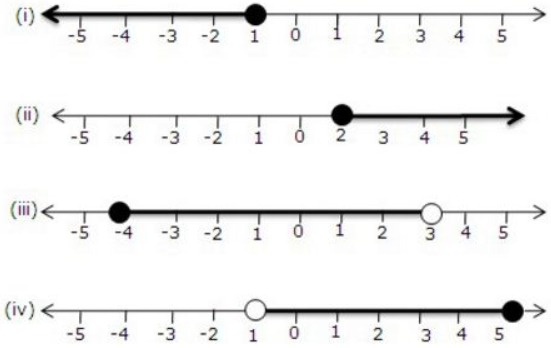
Sol: (i) x ≤ -1, x ∈ R
(ii) x ≥ 2, x ∈ R
(iii) -4 ≤ x < 3, x ∈ R
(iv) -1 < x ≤ 5, x ∈ R
Que-3: For the following inequations, graph the solution set on the real number line :
(i) -4 ≤ 3x-1 < 8 (ii) x-1 < 3-x ≤ 5
Sol: (i) -4 ≤ 3x-1 < 8
-4 ≤ 3x-1 and 3x-1 < 8
-1 ≤ x and x < 3
The solution set on the real number line is :

(ii) x-1 < 3-x ≤ 5
x-1 < 3-x and 3-x ≤ 5
2x < 4 and -x ≤ 2
x < 2 and x ≥ -2
The solution set on the real number line is :

Que-4: Represent the solution of each of the following inequalities on the real number line :
(i) 4x-1 > x+11 (ii) 7-x ≤ 2-6x (iii) x+3 ≤ 2x+9 (iv) 2-3x > 7-5x (v) 1+x ≥ 5x-11 (vi) {(2x+5)/3} > 3x-3
Sol: (i) 4x-1 > x+11
3x > 12
x > 4
The solution set on the real number line is :

(ii) 7-x ≤ 2-6x
5x ≤ -5
x ≤ -1
The solution set on the real number line is :

(iii) x+3 ≤ 2x+9
-6 ≤ x
The solution set on the real number line is :

(iv) 2-3x > 7-5x
2x > 5
x > 5/2
x > 2.5
The solution set on the real number line is :

(v) 1+x ≥ 5x-11
12 ≥ 4x
3 ≥ x
The solution set on the real number line is :

(vi) {(2x+5)/3} > 3x-3
2x+5 > 9x-9
-7x > -14
x < 2
The solution set on the real number line is :

Que-5: x ∈ {real numbers} and -1 < 3 – 2x ≤ 7, evaluate x and represent it on a number line.
Sol: -1 < 3 – 2x ≤ 7
-1 < 3 – 2x and 3 – 2x ≤ 7
2x < 4 and -2x ≤ 4
x < 2 and x ≥ -2
Solution set = {-2 ≤ x < 2, x ∈ R}
Thus, the solution can be represented on a number line as:

Que-6: List the elements of the solution set of the inequation
-3 < x – 2 ≤ 9 – 2x; x ∈ N.
Sol: -3 < x – 2 ≤ 9 – 2x
-3 < x – 2 and x – 2 ≤ 9 – 2x
-1 < x and 3x ≤ 11
-1 < x ≤ 11/3
Since, x ∈ N
∴ Solution set = {1, 2, 3}
Que-7: Find the range of values of x which satisfies
-2*(2/3) ≤ x+(1/3) < 3*(1/3); x ∈ R
Graph these values of x on the number line.
Sol: The given inequation has two parts:
−2*(2/3) ≤ 𝑥 +(1/3) and 𝑥 +(1/3) < 3*(1/3)
−8/3 ≤ 𝑥 +(1/3) and 𝑥 +(1/3) < 10/3
(−8/3) − (1/3) ≤ 𝑥 and 𝑥 < (10/3) − (1/3)
−9/3 ≤ 𝑥 and 𝑥 ≤ 9/3
-3 ≤ x and x < 3
-3 ≤ x < 3
∴ The required graph line is:

Que-8: Find the value of x, which satisfy the inequations :
-2 ≤ (1/2)-(2x/3) < 1*(5/6); x ∈ N.
Graph the solution on the number line.
Sol: −2 ≤ (1/2) − (2𝑥/3) ≤ 1*(5/6), x ∈ N
⇒ −2 − (1/2) ≤ (1/2) − (2𝑥/3) − (1/2) ≤ (11/6) − (1/2)
[By subtracting 1/2 on both sides of inequality]
⇒ −5/2 ≤ 2𝑥/3 ≤ 8/6
⇒ -15 ≤ – 4x ≤ 8
⇒ 15 ≥ 4x ≥ – 8
⇒ 15/4 ≥ x ≥ – 2
3*(3/4) ≥ x ≥ – 2
But x ∈ N, hence only possible solution for x = {1, 2, 3}
∴ The required graph line is:

Que-9: Given x ∈ {real numbers}, find the range of values of x for which -5 ≤ 2x – 3 < x + 2 and represent it on a number line.
Sol: -5 ≤ 2x – 3 < x + 2
-5 ≤ 2x – 3 and 2x – 3 < x + 2
-2 ≤ 2x and x < 5
-1 ≤ x and x < 5
Required range is -1 ≤ x < 5.
The required graph is:

Que-10: If 5x – 3 ≤ 5 + 3x ≤ 4x + 2, express it as a ≤ x ≤ b and then state the values of a and b.
Sol: 5x – 3 ≤ 5 + 3x ≤ 4x + 2
5x – 3 ≤ 5 + 3x and 5 + 3x ≤ 4x + 2
2x ≤ 8 and -x ≤ -3
x ≤ 4 and x ≥ 3
Thus, 3 ≤ x ≤ 4.
Hence, a = 3 and b = 4.
Que-11: Solve the following inequation and graph the solution set on the number line:
2x – 3 < x + 2 ≤ 3x + 5, x ∈ R.
Sol: 2x – 3 < x + 2 ≤ 3x + 5
2x – 3 < x + 2 and x + 2 ≤ 3x + 5
x < 5 and -3 ≤ 2x
x < 5 and -1.5 ≤ x
Solution set = {-1.5 ≤ x < 5}
The solution set can be graphed on the number line as:

Que-12: Solve and graph the solution set of:
(i) 2x – 9 < 7 and 3x + 9 ≤ 25, x ∈ R (ii) 2x – 9 ≤ 7 and 3x + 9 > 25, x ∈ I
(iii) x + 5 ≥ 4(x – 1) and 3 – 2x < -7, x ∈ R
Sol: (i) 2x – 9 < 7 and 3x + 9 ≤ 25
2x < 16 and 3x ≤ 16
x < 8 and x ≤ 5*(1/3)
∴ Solution set = {𝑥 ≤ 5*(1/3), 𝑥 ∈ 𝑅}
The required graph on number line is

(ii) 2x – 9 ≤ 7 and 3x + 9 > 25
2x ≤ 16 and 3x > 16
x ≤ 8 and x > 5*(1/3)
∴ Solution set = {5*(1/3) < 𝑥 ≤ 8, 𝑥 ∈ 𝐼} = {6, 7, 8}
The required graph on number line is

(iii) Given: x + 5 ≥ 4(x – 1) and 3 – 2x < –7
⇒ x + 5 ≥ 4x – 4
4x – x ≤ 5 + 4
3x ≤ 9
Dividing both sides by 3 we get,
x ≤ 3 …(i)
3 – 2x < –7
2x > 3 + 7
2x > 10
x > 5 …(ii)
From (i) and (ii) we get,
x ≤ 3 and x > 5
Que-13: Solve and graph the solution set of:
(i) 3x – 2 > 19 or 3 – 2x ≥ -7, x ∈ R
(ii) 5 > p – 1 > 2 or 7 ≤ 2p – 1 ≤ 17, p ∈ R
Sol: (i) 3x – 2 > 19 or 3 – 2x ≥ -7
3x > 21 or -2x ≥ -10
x > 7 or x ≤ 5
Graph of solution set of x > 7 or x ≤ 5 = Graph of points which belong to x > 7 or x ≤ 5 or both.
Thus, the graph of the solution set is:

(ii) 5 > p – 1 > 2 or 7 ≤ 2p – 1 ≤ 17
6 > p > 3 or 8 ≤ 2p ≤ 18
6 > p > 3 or 4 ≤ p ≤ 9
Graph of solution set of 6 > p > 3 or 4 ≤ p ≤ 9
= Graph of points which belong to 6 > p > 3 or 4 ≤ p ≤ 9 or both
= Graph of points which belong to 3 < p ≤ 9
Thus, the graph of the solution set is:

Que-14: The diagram represents two inequations A and B on real number lines :
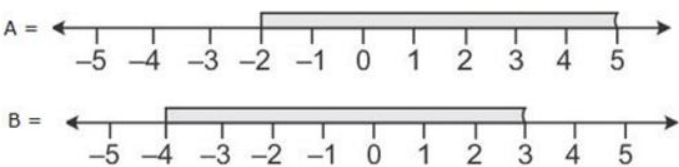
(i) Write down A and B in set builder notation.
(ii) Represent A∪B and A∩B’ on two different number lines.
Sol: (i) A = {x ∈ R: -2 ≤ x < 5}
B = {x ∈ R: -4 ≤ x < 3}
(ii) A ∩ B = {x ∈ R: -2 ≤ x < 5}
It can be represented on number line as:

B’ = {x ∈ R: 3 < x ≤ -4}
A ∩ B’ = {x ∈ R: 3 ≤ x < 5}
It can be represented on number line as:

Que-15: Use real number line to find the range of values of x for which:
(i) x > 3 and 0 < x < 6
(ii) x < 0 and -3 ≤ x < 1
(iii) -1 < x ≤ 6 and -2 ≤ x ≤ 3
Sol: (i) x > 3 and 0 < x < 6
Both the given inequations are true in the range where their graphs on the real number lines overlap.
The graphs of the given inequations can be drawn as:
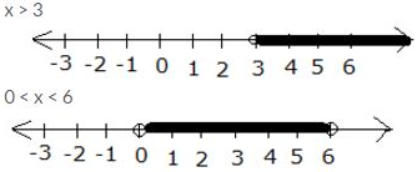
From both graphs, it is clear that their common range is
3 < x < 6
(ii) x < 0 and -3 ≤ x < 1
Both the given inequations are true in the range where their graphs on the real number lines overlap.
The graphs of the given inequations can be drawn as:
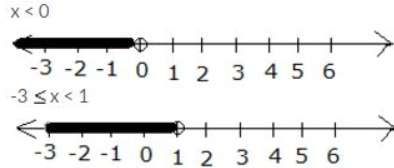
From both graphs, it is clear that their common range is
-3 ≤ x < 0
(iii) -1 < x ≤ 6 and -2 ≤ x ≤ 3
Both the given inequations are true in the range where their graphs on the real number lines overlap.
The graphs of the given inequations can be drawn as:
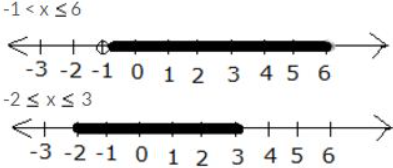
From both graphs, it is clear that their common range is
-1 < x ≤ 3.
Que-16: Illustrate the set {x: -3 ≤ x < 0 or x > 2, x ∈ R} on the real number line.
Sol: Graph of solution set of -3 ≤ x < 0 or x > 2
= Graph of points which belong to -3 ≤ x < 0 or x > 2 or both
Thus, the required graph is:

Que-17: Given A = {x: -1 < x ≤ 5, x ∈ R} and B = {x: -4 ≤ x < 3, x ∈ R}
Represent on different number lines:
(i) A ∩ B (ii) A’ ∩ B (iii) A – B
Sol: (i) A ∩ B = {x : –1 < x ≤ 3, x ∈ R}
It can be represented on a number line as

(ii) Numbers which belong to B but do not belong to A = B – A
A’ ∩ B = {x : – 4 ≤ x ≤ –1, x ∈ R}
It can be represented on a number line as

(iii) A – B = {x : 3 ≤ x ≤ 5, x ∈ R}
It can be represented on a number line as

Que-18: P is the solution set of 7x – 2 > 4x + 1 and Q is the solution set of 9x – 45 ≥ 5(x – 5); where x ∈ R. Represent:
(i) P ∩ Q (ii) P – Q (iii) P ∩ Q’ on different number lines.
Sol: P = {x : 7x – 2 > 4x + 1, x ∈ R}
7x – 2 > 4x + 1
7x – 4x > 1 + 2
3x > 3
x > 1
and
Q = {x : 9x – 45 ≥ 5(x – 5), x ∈ R}
9x – 45 ≥ 5x – 25
9x – 5x ≥ –25 + 45
4x ≥ 20
x ≥ 5
(i) P ∩ Q = {x : x ≥ 5, x ∈ R}

(ii) P – Q = {x : 1 < x < 5, x ∈ R}

(iii) P ∩ Q’ = {x : 1 > x < 5, x ∈ R}

Que-19: If P = {x : 7x-4 > 5x+2, x∈R} and Q = {x : x-19 ≥ 1-3x, x∈R}; find the range of set P∩Q and represent it on a number line.
Sol: P = {x : 7x – 4 > 5x + 2, x ∈ R}
7x – 4 > 5x + 2
7x – 5x > 2 + 4
2x > 6
x > 3
Q = {x : x – 19 ≥ 1 – 3x, x ∈ R}
x – 19 ≥ 1 – 3x
x + 3x ≥ 1 + 19
4x ≥ 20
x ≥ 5
P ∩ Q = {x : x ≥ 5, x ∈ R}
Que-20: Find the range of values of x, which satisfy:
−1/3 ≤ (𝑥/2) + {1*(2/3)} < 5*(1/6)
Graph in each of the following cases the values of x on the different real number lines:
(i) x ∈ W (ii) x ∈ Z (iii)x ∈ R
Sol: −1/3 ≤ (𝑥/2) + {1*(2/3)} < 5*(1/6)
(−1/3) − (5/3) ≤ (𝑥/2) < (31/6) − (5/3)
−6/3 ≤ 𝑥/2 < 21/6
– 4 ≤ x < 7
(i) If x ∈ W, range of values of x is {0, 1, 2, 3, 4, 5, 6}

(ii) If x ∈ Z, the range of values of x is {– 4, – 3, – 2, – 1, 0, 1, 2, 3, 4, 5, 6}

(iii) If x ∈ R, range of values of x is – 4 ≤ x < 7

Que-21: Given: A = {x: -8 < 5x + 2 ≤ 17, x ∈ I}, B = {x: -2 ≤ 7 + 3x < 17, x ∈ R}
Where R = {real numbers} and I = {integers}. Represent A and B on two different number lines. Write down the elements of A ∩ B.
Sol: A = {x : –8 < 5x + 2 ≤ 17, x ∈ I}
= {x : –10 < 5x ≤ 15, x ∈ I}
= {x : –2 < x ≤ 3, x ∈ I}
It can be represented on number line as

B = {x : –2 ≤ 7 + 3x < 17, x ∈ R}
= {x : –9 ≤ 3x < 10, x ∈ R}
= {x : –3 ≤ x < 3.33, x ∈ R}
It can be represented on number line as

A ∩ B = {–1, 0, 1, 2, 3}
Que-22: Solve the following inequation and represent the solution set on the number line 2x – 5 ≤ 5x +4 < 11, where x ∈ I
Sol: The given inequation is 2𝑥–5 ≤ 5𝑥+4 < 11, where x ∈ I
2𝑥 −5 ≤ 5𝑥 +4
2𝑥 −5𝑥 ≤ 4 +5
−3𝑥 ≤ 9
𝑥 ≥ −3
5x + 4 < 11
5x < 11 – 4
5x < 7
x < 1.4
Thus, the solution set = {x: x ∈ I, –3 <= x < 1.4}
The solution set can be represented on a number line as follows:

Que-23: Given that x ∈ I, solve the inequation and graph the solution on the number line :
3 ≥ {(x-4)/2}+(x/3) ≥ 2.
Sol: 3 ≥ {(𝑥−4)/2} + (𝑥/3) ≥ 2
3 ≥ {(3𝑥 −12+2𝑥)/6} ≥ 2
18 ≥ 3𝑥 −12 +2
18 +12 ≥ 5𝑥
30 ≥ 5𝑥
6 ≥ 𝑥
3 ≥ {(𝑥−4)/2} + (𝑥/3) ≥ 2
3 ≥ {(3𝑥 −12+2𝑥)/6} ≥ 2
5𝑥 −12 ≥ 12
5𝑥 ≥ 12 +12
5𝑥 ≥ 24
𝑥 ≥ 24/5
𝑥 ≥ 4.8
{x : 4.8 ≤ x ≤ 6, x ∈ I}
Solution set = {5, 6}
It can be graphed on number line as

Que-24: Given:
A = {x: 11x – 5 > 7x + 3, x ∈ R} and
B = {x: 18x – 9 ≥ 15 + 12x, x ∈ R}.
Find the range of set A ∩ B and represent it on number line.
Sol: A = {x: 11x – 5 > 7x + 3, x ∈ R}
= {x: 4x > 8, x ∈ R}
= {x: x > 2, x ∈ R}
B = {x: 18x – 9 ≥ 15 + 12x, x ∈ R}
= {x: 6x ≥ 24, x ∈ R}
= {x: x ≥ 4, x ∈ R}
A ∩ B = {x: x ≥ 4, x ∈ R}
It can be represented on number line as:

Que-25: Find the set of values of x, satisfying :
7x+3 ≥ 3x-5 and (x/4)-5 ≤ (5/4)-x where x ∈ N
Sol: 7𝑥 +3 ≥ 3𝑥 −5
4𝑥 ≥ −8
𝑥 ≥ −2
(𝑥/4) − 5 ≤ (5/4) −𝑥
(𝑥/4) + 𝑥 ≤ (5/4) + 5
(5𝑥/4) ≤ 25/4
𝑥 ≤ 5
Since, x ∈ N
∴ Solution set = {1, 2, 3, 4, 5}
Que-26: Solve : (i) (x/2)+5 ≤ (x/3)+6, where x is positive odd integer.
(ii) (2x+3)/3 ≥ (3x-2)/4, where x is a positive even integer.
Sol: (i) (𝑥/2) + 5 ≤ (𝑥/3) +6
(𝑥/2) − (𝑥/3) ≤ 6 −5
𝑥/6 ≤ 1
𝑥 ≤ 6
Since, x is a positive odd integer
∴ Solution set = {1, 3, 5}
(ii) (2𝑥+3)/3 ≥ (3𝑥−1)/4
8𝑥 +12 ≥ 9𝑥 −3
−𝑥 ≥ −15
𝑥 ≤ 15
Since, x is positive even integer
∴ Solution set = {2, 4, 6, 8, 10, 12, 14}
Que-27: Solve the inequation :
-2*(1/2) + 2x ≤ (4x/5) ≤ (4/3) + 2x, x ∈ W.
Graph the solution set on the number line.
Sol: −2*(1/2) + 2𝑥 ≤ (4𝑥/3) ≤ (4/3) + 2𝑥, 𝑥 ∈ W
(−5/2) + 2𝑥 ≤ (4𝑥/3) ≤ (4/3) + 2𝑥
−5/2 + 2𝑥 ≤ 4𝑥/3 and 4𝑥/3 ≤ (4/3) + 2𝑥
2𝑥 − (4𝑥/3) ≤ 5/2 and (4𝑥/3) − 2𝑥 ≤ 4/3
12x – 8x ≤ 15 and 4x – 6x ≤ 4
4x ≤ 15 and -2x ≤ 4
𝑥 ≤ 15/4 and −𝑥 ≤ 4
𝑥 ≤15/4 and 𝑥 ≥ 4
𝑥 ≤ 15/4 and −4 ≤ 𝑥
∴ −2 ≤ 𝑥 ≤ 15/4
∴ x = 0, 1, 2, 3
Solution set {x : x ∈ W, x ≤ 3}
Solution set on number line

Que-28: Find three consecutive largest positive integers such that the sum of one-third of first, one-fourth of second and one-fifth of third is at most 20.
Sol: Let the required integers be x, x + 1 and x + 2.
According to the given statement,
(1/3)𝑥 +(1/4)(𝑥+1) + (1/5)(𝑥+2) ≤ 20
(20𝑥+15𝑥+15+12𝑥+24)/60 ≤ 20
47𝑥 +39 ≤ 1200
47𝑥 ≤ 1161
𝑥 ≤ 24.702
Thus, the largest values of the positive integer x is 24.
Hence, the required integer are 24, 25 and 26.
Que-29: Solve the given inequation and graph the solution on the number line.
2y – 3 < y + 1 ≤ 4y + 7, y ∈ R
Sol: 2y – 3 < y + 1 ≤ 4y + 7, y ∈ R
⇒ 2y – 3 – y < y + 1 – y ≤ 4y + 7 – y
⇒ y – 3 < 1 ≤ 3y + 7
⇒ y – 3 < 1 and 1 ≤ 3y + 7
⇒ y < 4 and 3y ≥ 6 ⇒ y ≥ – 2
⇒ – 2 ≤ y < 4
The graph of the given equation can be represented on a number line as:

Que-30: Solve the inequation:
3z – 5 ≤ z + 3 < 5z – 9, z ∈ R.
Graph the solution set on the number line.
Sol: 3z – 5 ≤ z + 3 < 5z – 9
3z – 5 ≤ z + 3 and z + 3 < 5z – 9
2z ≤ 8 and 12 < 4z
z ≤ 4 and 3 < z
Since, z R
∴ Solution set = {3 < z ≤ 4, x ∈ R }
It can be represented on a number line as:

Que-31: Solve the following inequation and represent the solution set on the number line.
-3 < (-1/2) – (2x/3) ≤ 5/6, x ∈ R
Sol: −3 < −(1/2) − (2𝑥/3) ≤ 5/6
Multiply by 6, we get
⇒ −18 < −3 − 4𝑥 ≤ 5
⇒ −15 < −4𝑥 ≤ 8
Dividing by -4 we get
⇒ −15/−4 > 𝑥 ≥ 8/−4
⇒ −2 ≤ 𝑥 < 15/4
⇒𝑥 ∈ [−2, 15/4]
It can be represented on a number line as:

Que-32: Solve the following inequation and represent the solution set on the number line.
4x-19 < (3x/5)-2 ≤ (-2/5)+x, x ∈ R
Sol: The Given inequation is
4𝑥 −19 < (3𝑥/5)−2 ≤ (−2/5)+𝑥, x ∈ R
⇒(4𝑥−19) < (3𝑥−10)/5 ≤ (−2+5𝑥)/5
⇒ 5(4𝑥−19) < 3𝑥−10 < −2+5𝑥
⇒ 20𝑥 −95 < 3𝑥−10 ≤ −2+5𝑥
Solving 20𝑥 −95 <3𝑥 −10
⇒ 17𝑥 < 85
⇒ 𝑥 < 5
Solving 3x – 10 <= -2 + 5x
⇒ −2𝑥 ≤ 8
⇒ −𝑥 ≤ 4
⇒ 𝑥 ≥ −4
So the solution set = {𝑥: −4 ≤ 𝑥 < 5 , 𝑥 ∈ 𝑅}
It can be represented on a number line as:

Que-33: Solve the following inequation, write the solution set and represent it on the number line.
-x/3 ≤ (x/2) – {1*(1/3)} < 1/6, x ∈ R
Sol: The given equation is :
-x/3 ≤ (x/2) – {1*(1/3)} < 1/6, x ∈ R
-x/3 ≤ (x/2) – (4/3) < 1/6
Now,
(-x/3) ≤ (x/2) – (4/3) and (x/2) – (4/3) < 1/6
(-x/3) – (x/2) ≤ -4/3 and (x/2) < (1/6) + (4/3)
(2x+3x)/6 ≥ -4/3 and x/2 < (1+8)/6
5x/6 ≥ -4/3 and x/2 < 9/6
5x ≥ 8 and x/2 < 3/2
x ≥ 1.6 and x < 3
Solution set = {x : 1.6 ≤ x < 3}
It can be represented on a number line as:

Que-34: Find the values of x, which satisfy the equation
-2*(5/6) < (1/2)-(2x/3) ≤ 2, x ∈ W. Graph the solution set on number line.
Sol: Consider the given inequation :
-2*(5/6) < (1/2)-(2x/3) ≤ 2
-17/6 < (3-4x)/6 ≤ 12/6
17/6 > (4x-3)/6 ≥ -12/6
17 > 4x-3 ≥ -12
-12 < 4x-3 < 17
-12+3 ≤ 4x-3+3 < 17+3
-9 ≤ 4x < 20
-9/4 ≤ 4x/4 < 20/4
-9/4 ≤ x < 5
Since x ∈ W, the values of x are 0, 1, 2, 3, 4.
And the required line is :

Que-35: Solve the following in equation and write the solution set:
13x – 5 < 15x + 4 < 7x + 12, x ∈ R
Represent the solution on a real number line.
Sol: 13x – 5 < 15x + 4 < 7x + 12, x ∈ R
Take 13x – 5 < 15x + 4
13x < 15x + 9
0 < 2x + 9
– 9 < 2x
−9/2 <𝑥
and
15x + 4 < 7x + 12
15x < 7x + 8
8x < 8
x < 1
∴ −9/2 <𝑥 <1
i.e – 4.5 < x < 1
∴ Solution set = {x: – 4.5 < x < 1, x ∈ R}
The solution on the number line is as follows:

Que-36: Solve the following inequation, write the solution set and represent it on the number line.
-3(x – 7) ≥ 15 – 7x > (x+1)/3, x ∈ R.
Sol: -3(x – 7) ≥ 15 – 7x > (x+1)/3, x ∈ R.
-3(x-7) ≥ 15-7x and 15-7x > (x+1)/3
-3x+21 ≥ 15-7x and 45-21x > x+1
-3x+7x ≥ 15-21 and 45-1 > x+21x
4x ≥ -6 and 44 > 22x
x ≥ -3/2 and 2 > x
x ≥ -1.5 and 2 > x
The solution set is {x : x ∈ R, -1.5 ≤ x < 2}.
The solution on the number line is as follows:

Que-37: Solve the following inequation and represent the solution set on a number line.
-8*(1/2) < -(1/2) – 4x ≤ 7*(1/2), x ∈ I
Sol: -8*(1/2) < -(1/2) – 4x ≤ 7*(1/2), x ∈ I
(-15/2) < -(1/2) – 4x and -(1/2) – 4x ≤ 15/2
(-15/2) + (1/2) < -4x and -4x ≤ (15/2)+(1/2)
-14/2 < -4x and -4x ≤ 16/2
-7 < -4x and -4x ≤ 8
x < 4/7 and x ≥ 2
So, 7/4 > x ≥ 2, x ∈ I
x = {-2, -1, 0, 1, 2}

–: End of Representation of Solutions Set on Number Line Class 10 Concise Exe-4B :–
Return to :- – Selina Concise Solutions for ICSE Class-10 Maths
Please share with your friends
Thanks