Revenue and Demand Function Class 12 OP Malhotra Exe-26F ISC Maths Solutions Ch-26 Application of Calculus in Commerce and Economics. In this article you would learn about determination of revenue function and the demand function from marginal revenue function questions and answer. Visit official Website CISCE for detail information about ISC Board Class-12 Mathematics.



Revenue and Demand Function Class 12 OP Malhotra Exe-26F ISC Maths Solutions Ch-26 Application of Calculus in Commerce and Economics
| Board | ISC |
| Publications | S Chand |
| Subject | Maths |
| Class | 12th |
| Chapter-26 | Application of Calculus in Commerce and Economics |
| Writer | OP Malhotra |
| Exe-26(f) | Determination of Revenue and Demand Function from Marginal Revenue Function |
Determination of Revenue and Demand Function from Marginal Revenue Function
Application of Calculus in Commerce and Economics Class 12 OP Malhotra Exe-26F Solutions
Que-1: (i) The marginal revenue (in thousands of rupees) function for a particular commodity is 5 + 3e-0.03x, where x denotes the number of units sold. Determine the total revenue from the sale of 100 units.
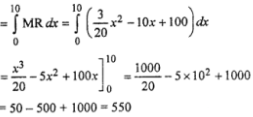
(ii) Find the total revenue from the sale of 10 units of output (x) from the marginal revenue given by MR = 1/2x2 – 10x + 100.
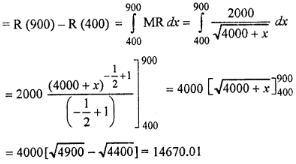
(iii) A manufacturers marginal revenue function is dR/dx = 2000/√4000+x. If x is in rupecs, find the change in the manufacturer’s total revenue if production is increased from 400 to 900 units.
Sol: (i) Given MR = 5 + 3e-0.03x
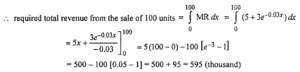
Thus, the required total revenue is ₹ 595000
(ii) Given MR = (3/20)x2 – 10x + 100 and (d/dx)R(x) = MR
∴ required total revenue from the sale of 10 units of output
(iii) Given MR = dR/dx = 2000/√4000−x and MR = (d/dx)R(x)
Required change in manufacture’s revenue if production is increased from 400 to 900 units
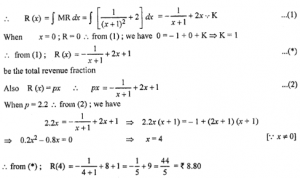
Que-2: If the marginal revenue function is given by MR = 1/(x+1)²+2, find the total revenue function. Also, find the total revenue when the price is ₹ 2.20.
Sol: Given marginal revenue function MR = 1/(x+1)²+2 and MR = (d/dx)R(x)
Que-3: Find the total revenue function and the demand function for the following revenue functions:
(i) MR = 9 – 6x² + 2x
(ii) MR = 9 – 4x²
(iii) MR = 20e-x/10(1−x/10)
(iv) MR = 1/x+1−5
(v) MR = 5/(3x+4)−7
(vi) MR = log(x + 2)
(vii) MR = a + 1/x+b – x/(x+b)²
Sol: (i) Given MR = 9 – x2 + 2x and MR = d/dxR(x)

When x = 0; R = 0 ∴ from (1); K = 0
Thus eqn. (1) reduces to; R(x) = 9x – 2x3 + x2 which is the required total revenue function
∴ px = 9x – 2x3 + x2 ⇒ p = 9 – 2x2 + x
which is the required demand function.
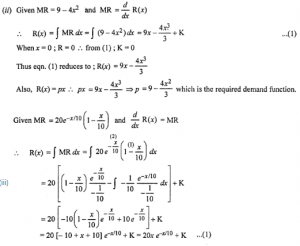
Since when x = 0; R = 0 ∴ from (1); K = 0
Thus eqn. (1) reduces to; R(x) = 20x e-x/10
which is the required total revenue function.
Since R(x) = p × x = 20x e-x/10 ⇒ p = 20e-x/10 be the required demand function.

when x = 0; R = 0 ∴ K = 0
Thus eqn. (1) redues to; R(x) = log |x + 1| – 5x
which is the required total revenue function
Since R(x) = px ∴ px = log | x + 1| – 5x
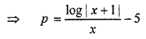
which is the required demand function.
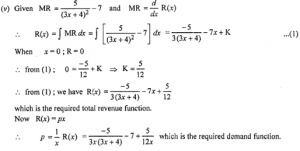
(vi) Given MR = log(x + 2) since MR = (d/dx)R(x)
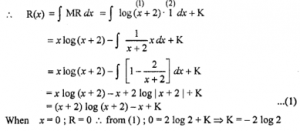
Thus, eqn. (1) reduces to ; R(x) = (x + 2) log (x + 2) – x – 2 log 2
Since p(x) = R(x)/x = (x+2)log(x+2)/x – 1 – 2log2/x
which is the required demand function.
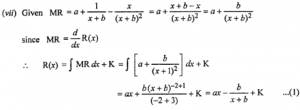
Given when x = 0; R = 0
∴ from (1); K = 1
Thus eqn. (1) reduces to ; R(x) = ax – b/x+b + 1
which is the required total revenue function
∴ p(x) = R(x)/x = a – b/x(x+b) + 1/x which is the required demand function.
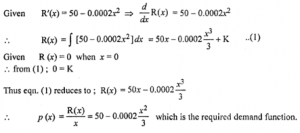
Que-4: The marginal revenue function of a monopolist is given as R'(x) = 50 – 0.0002x2, where R’ denotes marginal cost and x denotes the quantity produced and sold. It is known that total revenue is zero, when x = 0. Find the market demand function for the commodity.
Sol:
Que-5: If the marginal revenue function is given by MR = 9 – x2 bcing output find total revenue function, average revenue function and demand function.
Sol: Marginal revenue function (MR) = 9 – x2 since MR = (d/dx)R(x)

When x = 0; R(x) = 0 ∴ K = 0
Thus eqn. (1) reduces to ;R(x) = 9x – x³/3
∴ p(x) = R(x)/x = 9 – x²/3 which is the required demand function.
Thus average revenue function (AR) = R(x)/x = 9 – x²/3
Que-6: The marginal revenue function of a firm is given by MR = 25e-x/400(1−x/400), show that the corresponding demand function is p = 24e−x/400, where p is the price and x is quantity.
Sol: Marginal revenue function (MR) = 25e-x/400(1−x/400)
since MR = (d/dx)R(x)
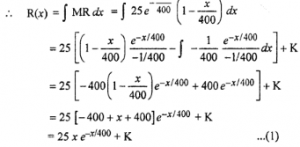
when x = 0 : R(x) = 0 ⇒ K = 0
Then eqn. (1) reduces to; R(x) = 25 × e−x/400
Thus p(x) = R(x/)x = 25e−x/400
which is the required demand function.
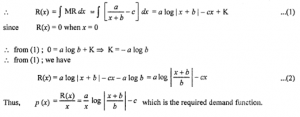
Que-7: A firm has marginal revenue function given by MR=(a/(x+b))−c, where x is the output and a, b, c are constants. Show that the demand law is given by MR=(a/(x+b))−c, where x is the output a, b, c are constants. Show that the demand law is given by p=(a/x)log(x+b/b)−c.
Sol: Given marginal revenue function (MR) = (a/(a+b))−c and MR = (d/dx)R(x)
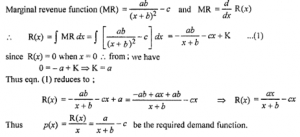
Que-8: If the marginal revenue function of a firm is MR=ab/(x+b)²−c, find the total revenue function and show that p=(a/(x+b))−c is the demand function where p is the price, x is the quantity demanded and a, b, c are constants.
Sol: Marginal revenue function (MR) =
Que-9: A firm’s marginal revenue function is given by MR = (a/(x+b))−ax/(x+b)²+c. Show that its demand function is p = (a/(x+b))+c, where a, b, c are constants.
Sol:
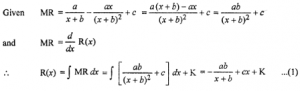
since R(x) = 0 when x = 0
∴ from eqn. (1); we have
0 = – a + K ⇒ K = a
∴ from eqn. (1); R(x) = −(ab/(x+b))+a+cx
∴ R(x) = −ab+ax+ab/x+b + cx ⇒ R(x) = (ax/(x+b)) +cx
∴ p(x) = R(x)/x = ax+b+c which is the required demand function.
–: End of Revenue and Demand Function Class 12 OP Malhotra Exe-26F ISC Maths Solutions :–
Return to :- OP Malhotra ISC Class-12 S Chand Publication Maths Solutions
Please share with your friends
Thanks