Surface Area and Volume of 3D Solids Class 9 OP Malhotra Exe-18B ICSE Maths Solutions Ch-18. We Provide Step by Step Solutions / Answer of Volume of Cube and Cuboid for OP Malhotra Maths. Visit official Website CISCE for detail information about ICSE Board Class-9 Mathematics.


Surface Area and Volume of 3D Solids Class 9 OP Malhotra Exe-18B ICSE Maths Solutions Ch-18
| Board | ICSE |
| Publications | S Chand |
| Subject | Maths |
| Class | 9th |
| Chapter-18 | Surface Area and Volume of 3D Solids |
| Writer | OP Malhotra |
| Exe-18B | Solved Questions on Volume of Cube and Cuboid |
| Edition | 2025-2026 |
Solved Questions on Volume of Cube and Cuboid
Surface Area and Volume of 3D Solids Class 9 OP Malhotra Exe-18B ICSE Maths Solutions Ch-18
Que-1: Find the volume of a rail of uniform cross-section, given area of cross-section 12.8 cm2, and length 1.26 cm.
Sol: Area of the cross-section of a rail = 12.8 cm2 and length = 1.26 cm
∴ Volume = area × length
=12.8 × 1.26 cm3 = 16.128 cm3
Que-2: Find the area of the cross-section, assuming it to be uniform, of a solid, given that its volume is 92.8 cm3, and length is 6.4 m.
Sol: Volume of a cross-section of a solid = 92.8 cm3
and its length = 6.4 m = 640 cm
∴ Area of the cross-section = Volume / Length
= 92.8/6.40 cm² = 0.145 cm²
Que-3: The dimensions of the L-shaped cross-section of bar, 2 m long, are shown in cm in figure. Find
(i) the volume of the bar.
(ii) the weight, if the material weighs 0.3 kg per cm3.
Sol: Length of cross-section of bar = 2 m = 200 cm
In the figure produced DC which meets AF at G
Now AG = 4 – (1/2) = 3*(1/2) cm
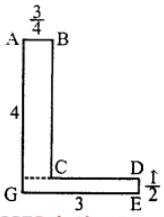
(i) ∵ Area of the figure of the cross-section = Area of ABCD + Area of GDEF
Area of ABCG = {3*(1/2)} × (3/4) = (7/2) × (3/4) = 21/8 cm²
∴ Total area = (21/8) + (3/2) = (21+12)/8 = 33/8 cm²
∴ Volume of the cross-section = Area × Length
= (33/8) × 200 = 33 × 25 cm³ = 825 cm³
(ii) Weight of 1 cm3 = 0.3 kg
∴ Total weight = 825 × 0.3 kg = 247.5 kg
Que-4: The dimensions of the cross-section of a girder, 2.5 m long, are shown in cm in the diagram. Find
(i) the volume of the girder,
(ii) the weight, if the material weighs 7.8 gm per cm2.
Sol: Length of cross section = 2.5 m = 250 cm In the given figure,
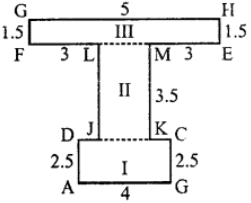
On joining LM and JK, we get three rectangles
∴ Area of rectangle I
=4 × 2.5 = 10 cm2
Area of rectangle II = 3.5 × (8 – 3 – 3)
= 3.5 × 2 = 7 cm2
and area of rectangle III = 8 × 1.5 = 12 cm2
∴ Total area of the cross section = 10 + 7 + 12 = 29 cm2
(i) ∴ Volume = Area × Length
= 29 × 250 = 7250 cm3
(ii) Weight of 1 cm3 = 7.8 gm
∴ Total weight = 7.8 × 7250 gm = 56550 gm = 56.55 kg = 57 kg (approx)
Que-5: The cross-area of a pipe is 42 cm2, and water is pouring out of it at the rate of 1.25 m per sec. If the pipe remains full, find the number of litres discharged per minute.
Sol: Area of cross-section of a pipe = 42 cm²
= 42/(100×100) m²
Rate of water pouring = 1.25 m per sec
Rate of water per minute = 1.25 m × 60 = 75.00 m per minute
∴ Volume of water in the pipe
= 42/(100×100) × 75 = 0.315 m³
Water in litres = 0.315 × 1000
= 315 litres (1 m² = 1000 l)
Que-6: The figure shows a solid of uniform crosssection. Find the volume of the solid. All measurements are in centimetres. Assume that all angles in the figure are right angles.
Sol: Length of the cross-section = 4 c
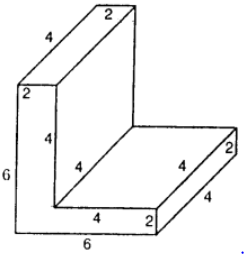
Area of the cross-section = 4 × 2 + 6 × 2
= 8 + 12 = 20 cm2
∴ Volume = Area × Length
= 20 × 4 = 80 cm3
Que-7: A swimming pool is 50 m long and 15 m wide. Its shallow and deep ends are 1*(1/2) m and 4*(21/8) m deep respectively. If the bottom of the pool slopes uniformly, find the amount of water in litres required to fill the pool.
Sol: Length of swimming pool (l) = 50 m and width (b) = 15 m
Depth of water in one side = 1*(1/2) m
and other side = 4*(1/2) m
∴ Mean depth (h) = (1/2) [{1*(1/2)}+{4*(1/2)}]m
= (1/2) × 6 = 3 m
∴ Volume of the pool = lbh
= 50 + 15 × 3 = 2250 m3
∴ Volume of water in litres = 2250 × 1000 l (1 m3 = 1000 l) = 2250000 litres
Que-8: The area of cross-section of a pipe is 5.4 cm2 and water is pumped out of it the rate of 27 km / h. Find in litres the volume of water which flows out of the pipe in one minute.
Sol: Area of the cross section = 5.4 cm² Flows of water = 27 km / h
Flow of water in 1 minute = (27×1000)/60m = 450 m
∴ Volume of the water = 5.4/(100×100) × 450 m³ = 6.243 m³
∴ Water in litres = 0.243 × 1000 litres (1 m3 = 1000 l) = 243 litres
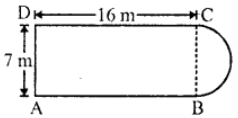
Que-9: The horizontal cross-section of a water tank is in the shape of a rectangle with a semicircle at one end, as shown in figure. The water is 2.4 m deep in the tank. Calculate the volume of water in the tank in gallons.
Sol: Area of the cross-section of the tank = area of rectangle ABCD + area of semicircle or BC
= l × b + (1/2)πr²
= 16 × 7 + (1/2) × (22/7) × (7/2) × (7/2) m² (r = 7/2 m)
= 112 + (77/4) = (448+77)/4 = 525/4 m²
Depth of water in the tank = 2.4 m
∴ Volume of water = area × depth
= (525/4) × 2.4 m³ = 315 m³ {1m³ = 1000 l}
Water in gallons = 315 × 1000 l
= (315×1000)/4.5 gallons {4.5 l = 1 gallon}
& =70000 gallon
Que-10: In the figure, shows the end face of a triangular girder which is 5 m long. Find the volume of metal used in casting it. (Units in cm).
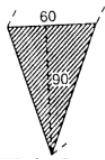
Sol: Cross-section of the girder is triangular whose base (b) = 60 m and height (h) = 90 cm
∴ Area of the face of the girder
= (1/2) × b × h = (1/2) × 60 × 90 cm² = 2700 cm²
Length of girder = 5 m
∴ Volume of metal used
= Area × Length
= (2700×5)/(100×100) m³
= 135/100 m³ = 1.35 m³
Que-11: In the figure shows the end-view of a swimming pool which is 10 m wide. Calculate the volume of water when it is full of water 1/2 m from the top.
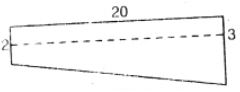
Sol: Width of pool = 10 m
Water = 1/2 m from the top
Length = 20 m
∴ Height of water from one side = 2 – 1/2
= 1*(1/2) m
∴ Average height = 1/2 [{1*(1/2)} + {2*(1/2)}]
= 1/2 × 4 = 2 m
∴ Volume of water in the pool = l × b × h
= 20 × 10 × 2 m3 = 400 m3
Que-12: In the figure shows the end-face of a garage which is 20 m long.
(i) Find the area of the end-face.
(ii) Find the volume of air-space of the garage in m3.
(iii) If 40 m3 of air is required per worker, how many workers can be employed in this garage ?
Sol: Length of garage = 20 m
By joining BF, we get the end face of the garage, one rectangle and one triangle
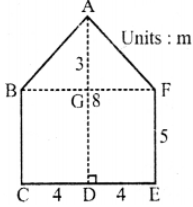
Area of rectangle BCEF = CE × BC = 8 × 5 = 40 m²
and area of triangle ABF
= 1/2 BF × AG
= 1/2 × 8 × 3 = 12 m²
(i) ∴ Total area of the end-face = 40 + 12 = 52 m²
(ii) Volume of the air space = area × length = 52 × 20 = 1040 m³
(iii) For one worker air is required = 40 m³
∴ No. of workers = 1040/40 = 26
–; End of Surface Area and Volume of 3D Solids Class 9 OP Malhotra Exe-18B ICSE Maths Solutions Ch-18 :–
Return to :– OP Malhotra S Chand Solutions for ICSE Class-9 Maths
Thanks
Please Share with Your Friends